
Origins of Symbols · Runic History
Rune Alphabets: Elder Futhark, Younger Futhark, and Futhorc
- Author
- Editorial Board, Orphic Meridian Association
- Date
- 2025-10-01
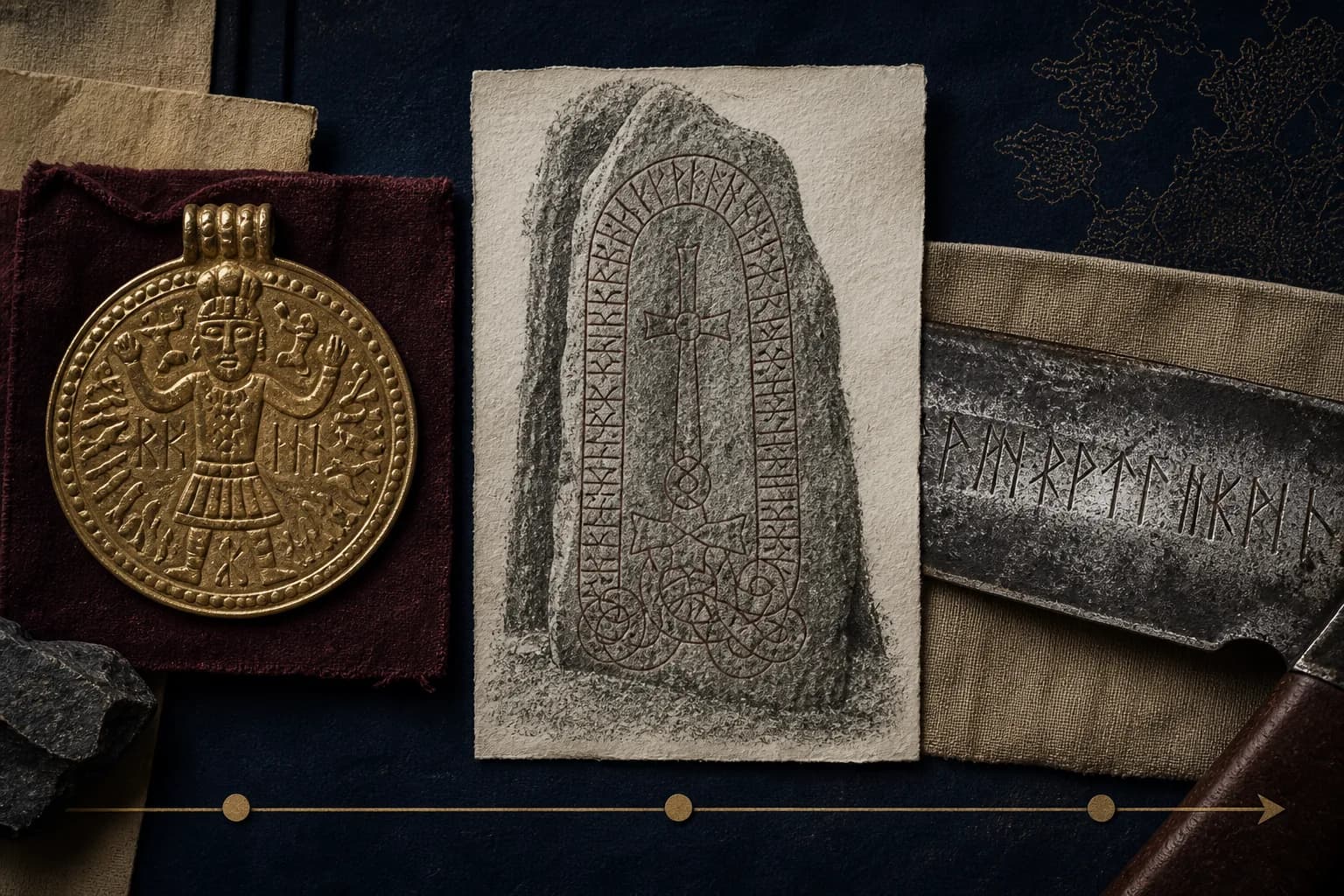
Elder Futhark, Younger Futhark, and Anglo-Frisian Futhorc are three related rune alphabets, not three fonts for one fixed system. Elder Futhark normally has twenty-four characters, Viking Age Younger Futhark sixteen, and Anglo-Saxon Futhorc expanded as English and Frisian sound systems changed.
Elder Futhark has twenty-four characters
Elder Futhark is the earliest extensively attested rune row, used mainly for Germanic inscriptions from roughly the second to eighth centuries. Futhark is formed from its first six sound values, as alphabet comes from alpha and beta.
Its inscriptions are often short and its forms vary. A modern printed chart should not be mistaken for a uniform historical typeface.
Younger Futhark reduced the inventory
Viking Age Younger Futhark usually has sixteen basic characters. Old Norse sound distinctions increased while the number of runes decreased, leaving one rune to represent multiple sounds. Context became essential for reading.
Long-branch and short-twig forms add further variation. A product that silently restores Younger Futhark to twenty-four pieces has mixed systems.
Futhorc expanded for new sounds
In England and Frisia, the row expanded to twenty-eight, thirty-three, or other counts. Its name changed to futhorc, reflecting the altered early sound values. The Thames scramasax in the British Museum carries a complete sequence important to the study of English runes.
Identify the row before using it
Before transliterating a name, examining an inscription, or building a symbolic method, state the rune row and period. Similar-looking characters may differ in name or sound, and a missing sign should not be borrowed from another row without explanation.
A “complete rune set” is always complete for something
A twenty-four-piece set is complete for the normalized Elder Futhark row, not for every runic inscription. A sixteen-piece set may be appropriate to Younger Futhark, while an English inscription may require signs from expanded Futhorc. Completeness depends on language and period.
This is a practical test for reproductions and jewelry. If an object is advertised as Viking Age but uses the full twenty-four Elder Futhark sequence, ask for its model, date, and transliteration. The combination may be a conscious modern design, but it should not be mistaken for an ordinary Viking Age spelling system.
Next read how rune poems preserve names, which names are reconstructed, and why the blank rune is a modern addition.
References
Related articles
Origins of Symbols · Runic History
Is the Blank Rune Historical? Its Modern Origin Explained
The blank rune is not historical Elder Futhark. It entered modern rune divination through Ralph Blum's 1982 book and commercial rune set.
Origins of Symbols · Runic History
Is Casting Runes on Cloth an Ancient Method?
Ancient texts attest lot-casting and ritual uses of runes, but not the complete cloth-casting procedure common in modern rune divination.
Origins of Symbols · Runic History
How Many Rune Names and Meanings Are Modern Reconstructions?
Some rune names are directly attested in medieval sources; others are reconstructed from later evidence, cognates, and regular sound changes.