
Origins of Symbols · Runic History
Is Casting Runes on Cloth an Ancient Method?
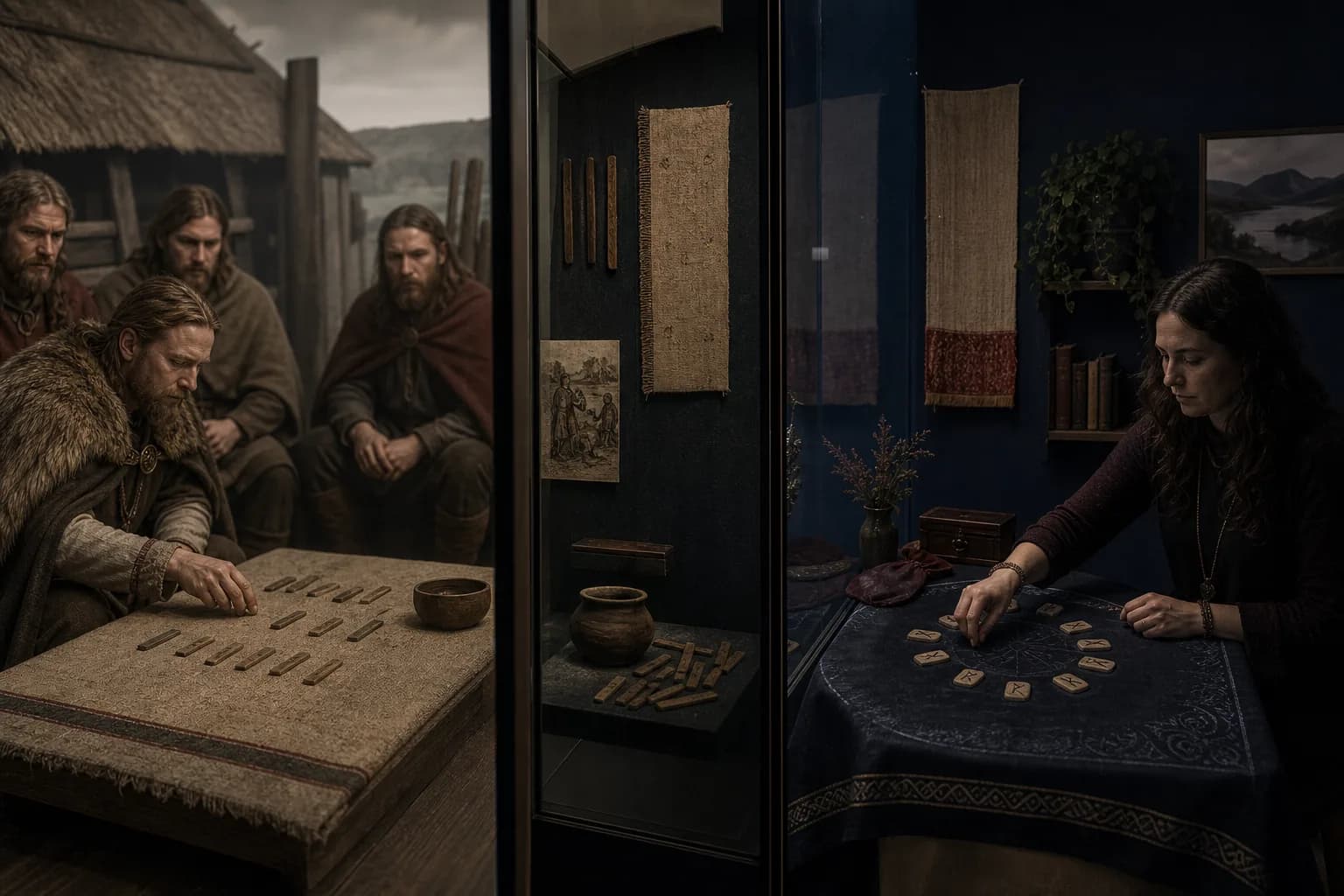
- Author
- Editorial Board, Orphic Meridian Association
- Date
- 2025-12-24
Pouring runes onto a cloth and reading their direction, distance, and landing place is common today. Existing evidence does not show that this complete procedure survived unchanged from the Viking Age. It combines an ancient lot-casting report, runic symbolism, and modern divinatory design.
What Tacitus actually described
In the first century, Tacitus wrote that people cut slips from a fruit-bearing tree, marked them, scattered them on a white cloth, and selected three for interpretation by a priest or head of household.
The details resemble modern practice: wood, marks, white cloth, and random selection. Tacitus did not draw the marks, identify them as Elder Futhark, or provide twenty-four meanings.
Scattering is not the same as reading every landing
The passage describes scattering and then selecting three pieces. Modern systems may read every rune's face, direction, position inside a circle, and distance from other pieces. These can be expressive rules, but they are additional procedures.
Ask of each step whether it is documented, supplied by a modern author, or created for consistent personal practice.
Consistency matters more than a claim of antiquity
Set rules before casting: what happens outside the cloth, whether sideways positions matter, how symmetrical runes are handled, and how many pieces are read. Draw or photograph the layout and distinguish observations made at the time from later associations.
Calling it “a modern method inspired by an ancient lot-casting account” respects both evidence and practice.
Make the procedure reviewable
Before a session, define the cloth boundary, how many pieces are read, what happens to pieces outside the boundary, and whether orientation matters. Draw or photograph the landing pattern and preserve the order of any later selection. Symmetrical runes need an explicit rule if the method otherwise relies on reversal.
Afterward, separate observations recorded at the time from associations added during interpretation. This creates a record that another practitioner can understand and that the original reader can revisit. Methodological consistency offers more practical continuity than an unsupported claim that every step has remained unchanged for two thousand years.
For context, read why runes are not Norse tarot and the history of the modern blank rune.
References
Related articles
Origins of Symbols · Runic History
Is the Blank Rune Historical? Its Modern Origin Explained
The blank rune is not historical Elder Futhark. It entered modern rune divination through Ralph Blum's 1982 book and commercial rune set.
Origins of Symbols · Runic History
How Many Rune Names and Meanings Are Modern Reconstructions?
Some rune names are directly attested in medieval sources; others are reconstructed from later evidence, cognates, and regular sound changes.
Origins of Symbols · Runic History
How Rune Poems Help Us Understand Rune Names
Rune poems preserve names and cultural associations, but they are later texts from different regions—not one ancient divination manual.