
Origins of Symbols · Runic History
How Rune Poems Help Us Understand Rune Names
- Author
- Editorial Board, Orphic Meridian Association
- Date
- 2025-10-22
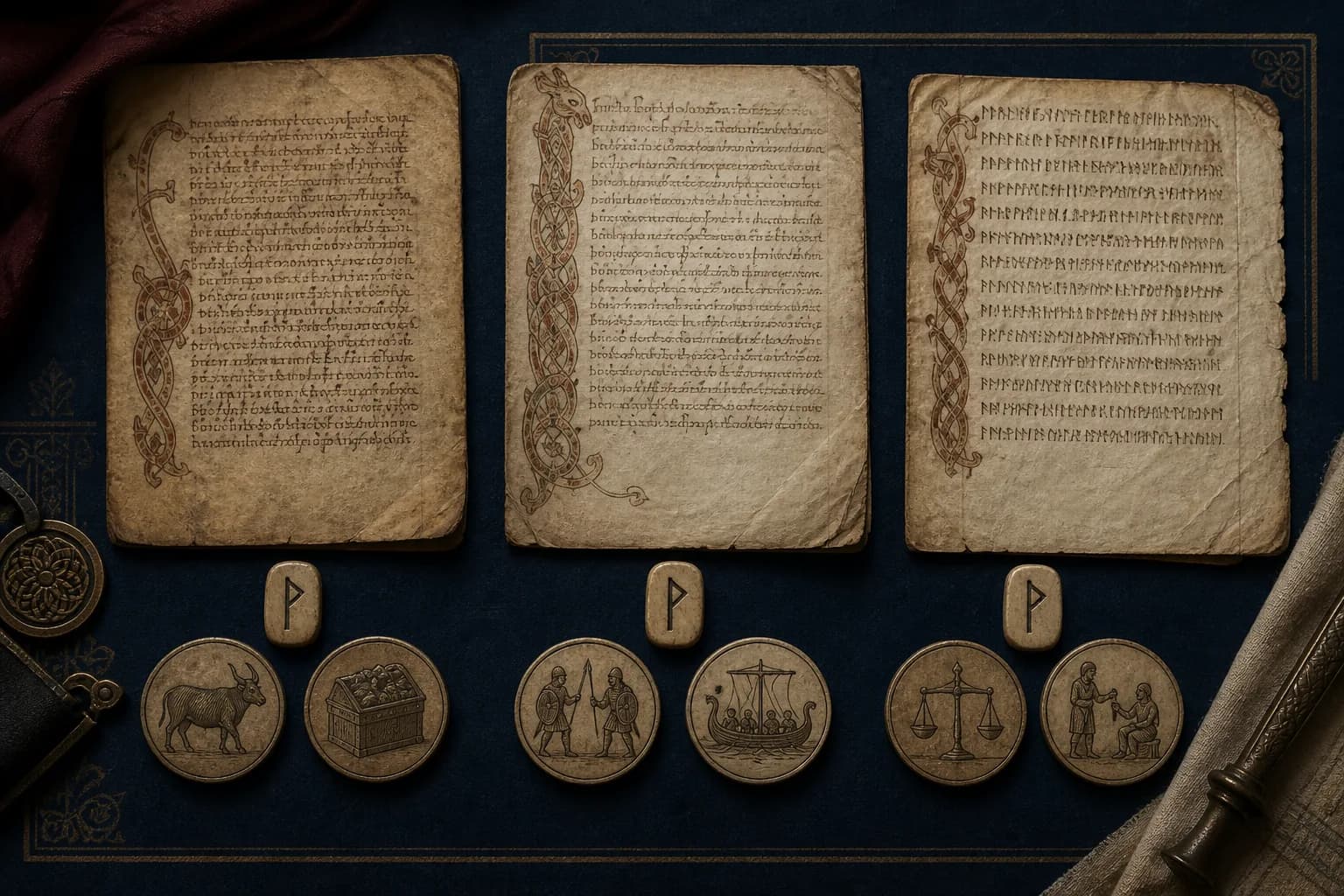
Rune poems are indispensable sources for rune names, but they are not a unified handbook preserved from the Elder Futhark period. The surviving Old English, Norwegian, and Icelandic traditions are later and accompany different rune rows.
The verses help readers remember writing
A rune name usually begins with the sound represented by the character. A short verse makes the name memorable and preserves cultural associations around its word. “Wealth” may describe useful property and also the conflict that wealth creates among relatives.
The verses speak through concrete experience: hail damages crops, travel tires a horse, and the sea contains fish despite appearing boundless. Reducing this material to “abundance,” “change,” or “protection” removes much of what the source contributes.
Three traditions do not make one original poem
The Old English poem accompanies expanded Futhorc; Norwegian and Icelandic poems mainly concern Younger Futhark. Related names can be compared, but their differences record language and culture rather than textual corruption.
Modern lists also mark reconstructed forms such as *fehu with an asterisk. In historical linguistics the mark means the exact form is inferred from later names, cognates, and sound changes rather than directly attested.
Show the steps from poem to interpretation
Read the object and situation in the verse, identify its tension, and only then relate it to a present question. Wealth may involve possession, circulation, obligation, and dispute—not simply gain.
Cite the poem tradition and translation. “An ancient rune poem says” collapses separate sources and prevents verification.
Translation is already an interpretation
Several words in the poems have uncertain readings or meanings shaped by their local language. A smooth modern English line can conceal a manuscript variant, editorial emendation, or choice among possible senses. When a single word supports an elaborate symbolic claim, compare more than one translation and, where possible, the edited source text.
The aim is not to make every use academic. A short source note—Old English poem, named translation, stanza for the relevant rune—usually provides enough of a trail. It also lets a later reader distinguish what the poem actually evokes from the lesson a modern author has built around it.
Continue with the three major rune rows and the evidence behind reconstructed rune names.
References
Related articles
Origins of Symbols · Runic History
Is Casting Runes on Cloth an Ancient Method?
Ancient texts attest lot-casting and ritual uses of runes, but not the complete cloth-casting procedure common in modern rune divination.
Origins of Symbols · Runic History
Is the Blank Rune Historical? Its Modern Origin Explained
The blank rune is not historical Elder Futhark. It entered modern rune divination through Ralph Blum's 1982 book and commercial rune set.
Origins of Symbols · Runic History
How Many Rune Names and Meanings Are Modern Reconstructions?
Some rune names are directly attested in medieval sources; others are reconstructed from later evidence, cognates, and regular sound changes.