
Origins of Symbols · Runic History
How Many Rune Names and Meanings Are Modern Reconstructions?
- Author
- Editorial Board, Orphic Meridian Association
- Date
- 2025-11-12
Modern charts often present twenty-four rune names, translations, and spiritual definitions as a completely preserved ancient lesson. The evidence is less tidy: some names are attested later, some reconstructed through related words and sound laws, and a few remain disputed.
Reconstruction is not guesswork
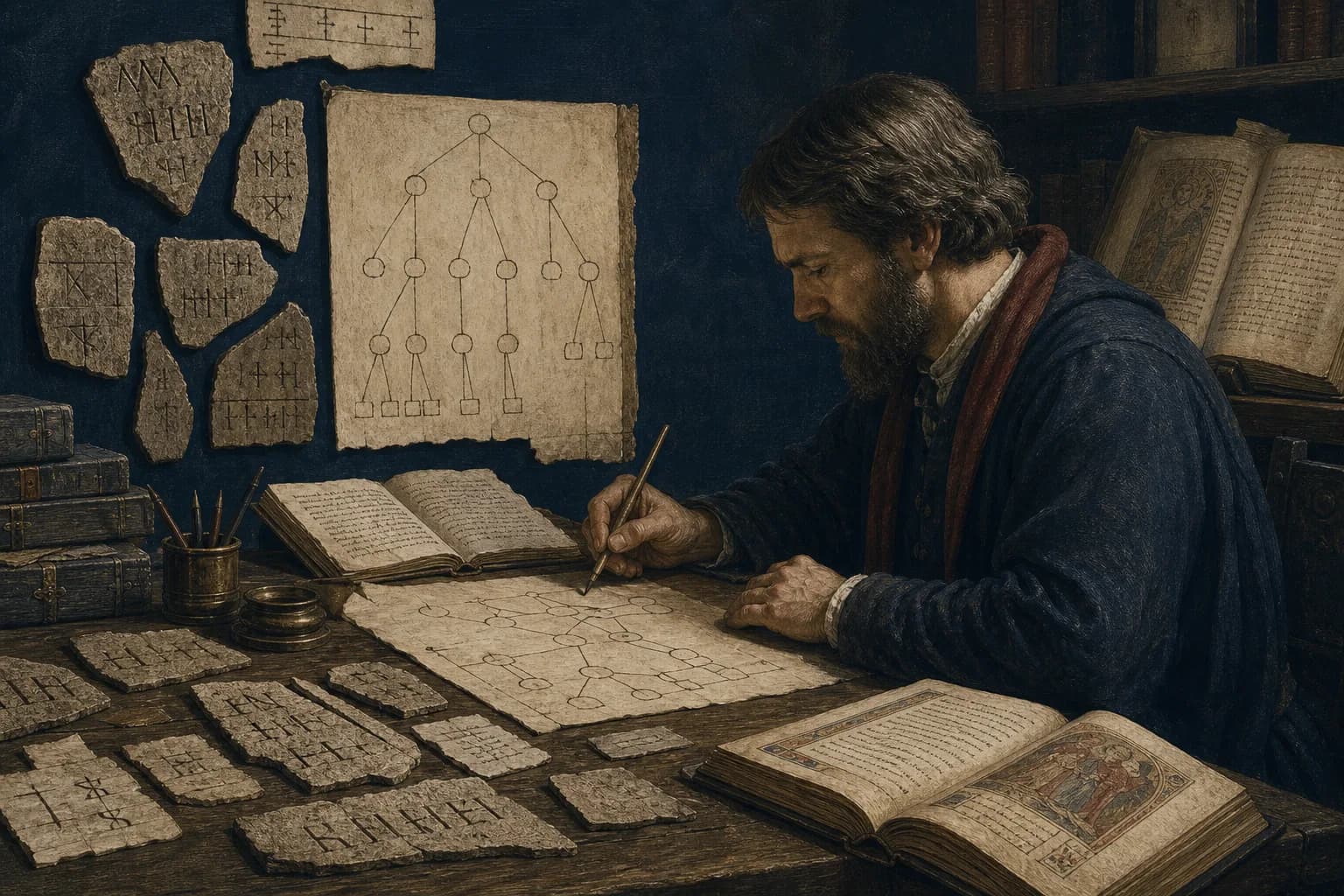
Historical linguists compare related forms and regular sound changes to infer an earlier form that was not written down in surviving evidence. An asterisk marks such a reconstruction. Words for sun, human being, or birch across Germanic languages can help recover an older rune name.
A strong reconstruction explains several descendants and fits known changes. It remains a model, not a complete second-century list found on an artifact.
Evidence has layers
First comes the inscription: character, order, object, and context. Second come medieval rune poems and lists that directly record names in a time and place. Third come modern linguistic reconstructions. Divination books often add a fourth layer of psychological advice.
The fourth may be useful, but it should not impersonate the first three. Disputed names deserve visible question marks; perþō, for example, has inspired confident translations that go beyond what is settled.
Build a source-aware table
Record form, sound, attested name, reconstructed name, literal sense, rune-poem passage, and source of any modern interpretation separately. Preserve “unknown” and “disputed” as meaningful states. A blank cell can carry more information than an invented certainty.
Confidence should travel with the claim
An attested medieval name can be quoted with its source. A reconstructed earlier form should retain its asterisk. A disputed literal meaning should present the main proposals rather than turning the most attractive one into a fact. Modern psychological associations need an author and publication date.
This method allows correction without collapsing the whole system. A new reading of one inscription may change an attestation, while a modern reflective exercise can remain useful on its own terms. Evidence-aware labels make revision possible; a seamless “ancient meaning” table makes every layer depend on the weakest claim.
See how rune poems should be read and the modern case of the blank rune.
References
Related articles
Origins of Symbols · Runic History
Is Casting Runes on Cloth an Ancient Method?
Ancient texts attest lot-casting and ritual uses of runes, but not the complete cloth-casting procedure common in modern rune divination.
Origins of Symbols · Runic History
Is the Blank Rune Historical? Its Modern Origin Explained
The blank rune is not historical Elder Futhark. It entered modern rune divination through Ralph Blum's 1982 book and commercial rune set.
Origins of Symbols · Runic History
How Rune Poems Help Us Understand Rune Names
Rune poems preserve names and cultural associations, but they are later texts from different regions—not one ancient divination manual.