
Books · Icelandic Magical Staves
Galdrastafir: How a Stave Manuscript Became a New Printed Edition
- Author
- Editorial Board, Orphic Meridian Association
- Date
- 2025-09-17
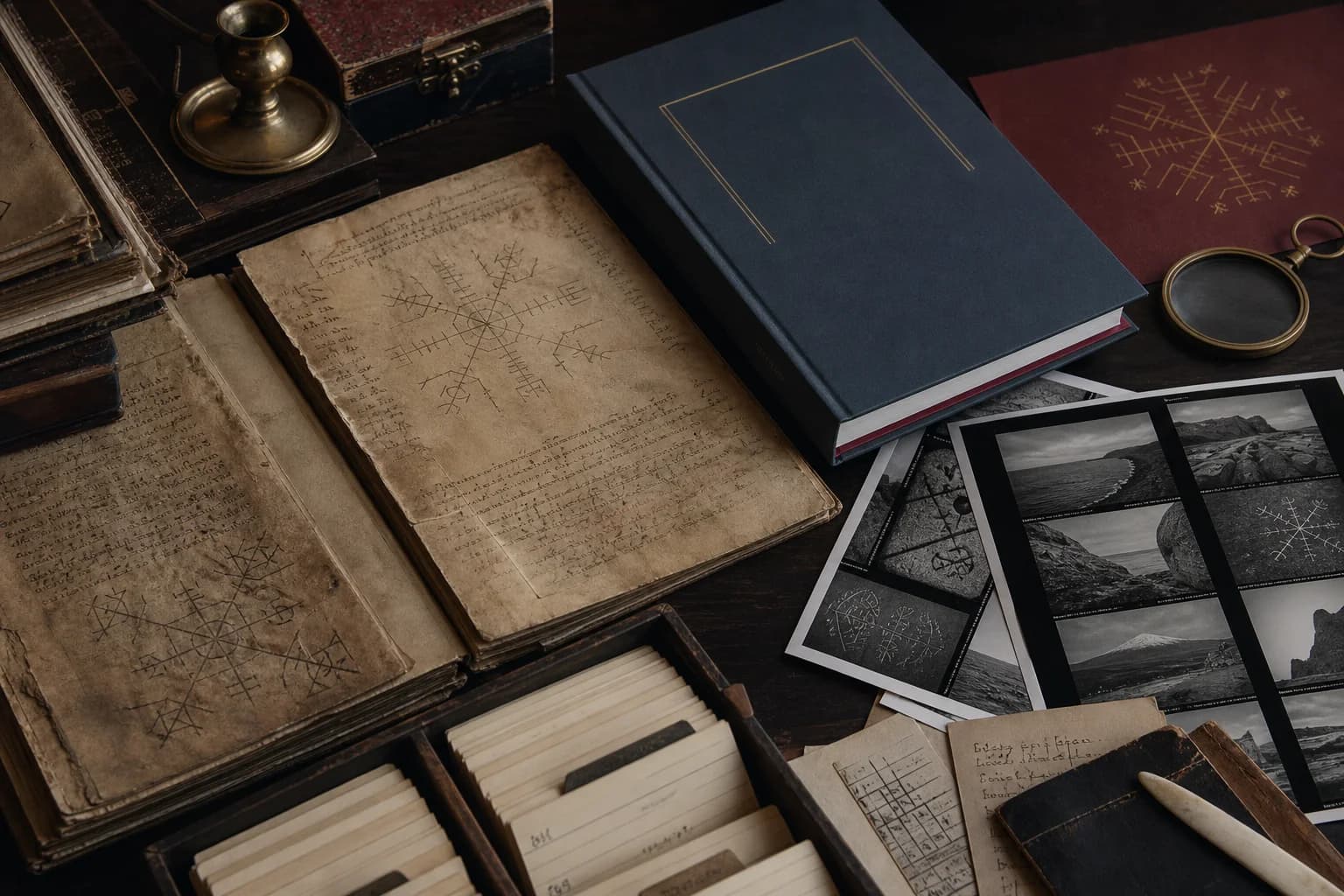
The 2025 paperback Galdrastafir: Historical Icelandic Magic Symbols is not simply another collection of symbols gathered from the internet. It is organized around material with an identifiable compiler and a traceable history.
Who assembled the material?
Jónas Jónasson (1856–1918) was an Icelandic priest, folklore collector, and antiquarian. He gathered magical staves from several sources and titled the resulting manuscript Galdrastafir. His work belongs to a transitional moment when older practices were declining while antiquarian and folkloric collection was expanding.
The new edition is prepared by Kári Pálsson and Giorgia Sottotetti. Publisher information describes a 300-page volume with an introduction by Alessia Bauer, photographs by Sottotetti, and illustrations by Leodrune. Its novelty lies in presentation and editorial framing; the staves themselves are historical material.
Why editorial history matters
One stave can vary across manuscripts in shape, name, and instruction. Modern charts often flatten those differences into a single standardized image. Identifying who copied or compiled a sign—and from what source—helps distinguish an original manuscript witness, a later copy, and a modern redrawing.
Historical material is not automatically transparent. Jónasson's selection, the editors' arrangement, and the illustrators' reconstructions all belong to the route by which a manuscript becomes a modern book.
Not a Viking-age symbol manual
The principal documentary setting of galdrastafir is early modern and later Icelandic magic. Christian language, folk practice, European ritual magic, and runic elements can appear together. Calling the whole collection “Viking runes” removes the historical mixture that makes it significant.
The value of a sourced edition is not that it demonstrates supernatural efficacy. It allows readers to compare forms, instructions, and lines of transmission.
A useful way to take notes
For each stave, record its manuscript or compilation source, Icelandic name, original instruction, translation, and visual variants. If an author adds a modern practice, place it in a separate field from the historical description. That record is more useful than an isolated image saved without provenance.