
Origins of Symbols · History of Astrology
FDL-012
Why Birth Charts Differ by Location at the Same Moment
- Author
- Editorial Board, Orphic Meridian Association
- Date
- 2025-08-20
- Reading time
- 3 min
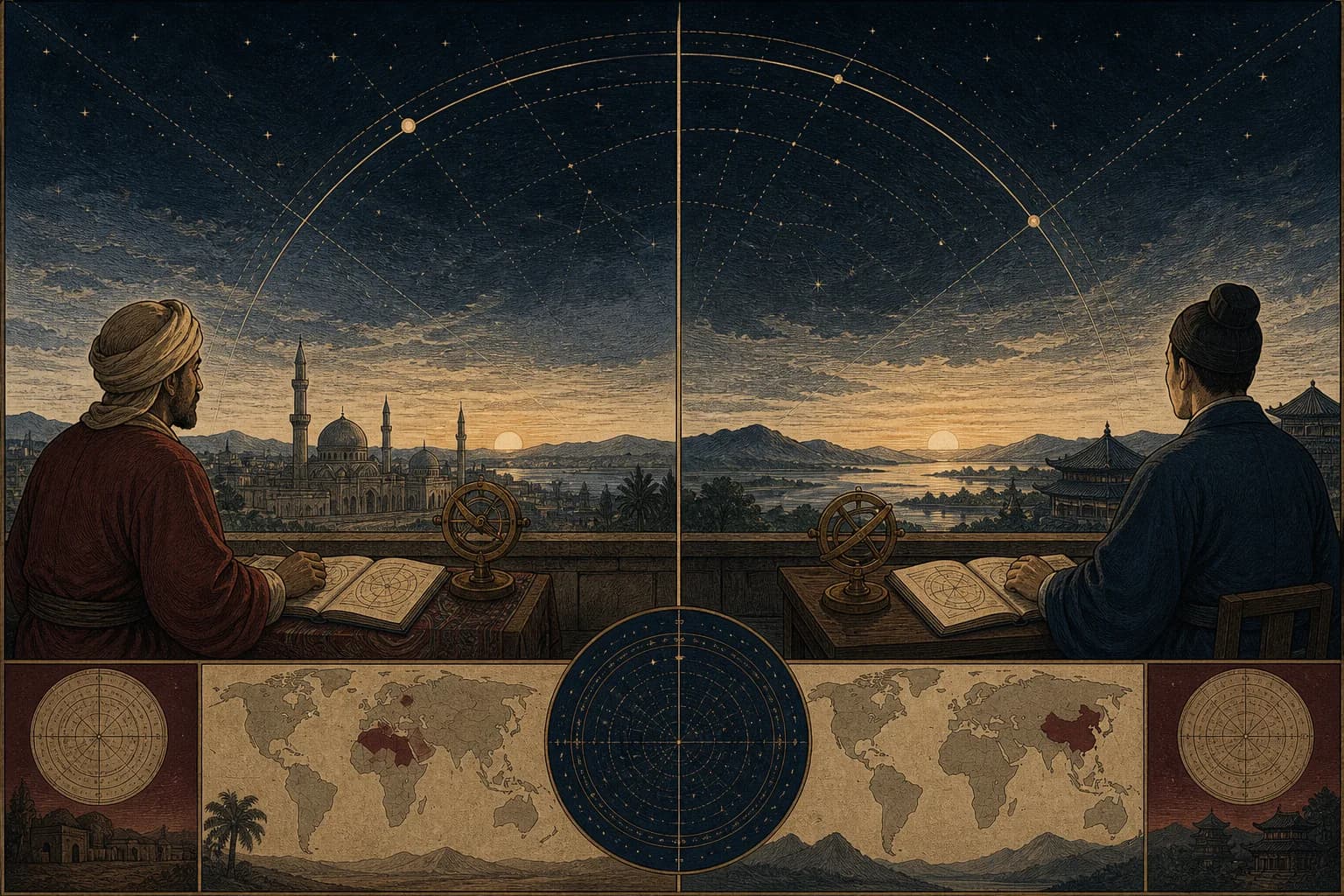
Two people born in the same second have nearly identical planetary longitudes, yet their Ascendants, Midheavens, and houses can differ. A birth chart does not depict only “the universe at that instant.” It also depicts the sky from a particular place on Earth.
Every location has its own horizon
Earth is spherical. The degree rising in the east in Shanghai is not the same degree rising in London. The Ascendant is the intersection of the ecliptic with the local eastern horizon; the Midheaven is related to the local meridian. Change latitude or longitude and these intersections move.
This is why signs may remain the same while houses change. Signs mostly depend on celestial longitude at a moment; houses place those positions inside a framework built from the local horizon and meridian. A chart preserves both when and where.
Time zones convert clocks into instants
A birth certificate records local civil time. Software must know the historical time-zone rule, daylight-saving status, and any change to a jurisdiction's standard time before converting the entry to Universal Time.
“8:00 a.m.” in two countries does not identify one instant, while one instant appears under different clock readings around the world. Confusing clock labels with instants is a common source of chart error.
Use location precision proportionately
Nearby cities seldom change a slow planet's sign, though they can move angles and cusps. If the birth time was rounded to the hour or half-hour, coordinates for a specific hospital building cannot repair that uncertainty.
Preserve the original record and state the source and precision of both time and place. When time is uncertain, test the documented range for boundary changes instead of reverse-engineering an unverifiable minute from later events.
Precision should follow the source
A chart calculated to the second is not necessarily based on second-level evidence. Hospital records may be rounded; family memory may compress a period into “around dawn.” Software can display more digits than the source justifies.
Record an interval when that is what the evidence supplies. Calculate its beginning and end, then identify which features remain stable and which cross a boundary. This produces a useful result even without a single exact Ascendant. It also prevents later events from being used to manufacture a precise birth time that can no longer be independently checked.
For the underlying calculation choices, read how the twelve houses developed. For terminology, see constellations, signs, and the zodiacal belt.