
Origins of Symbols · History of Astrology
Why Astrological Aspects Use 0°, 60°, 90°, 120°, and 180°
- Author
- Editorial Board, Orphic Meridian Association
- Date
- 2025-07-30
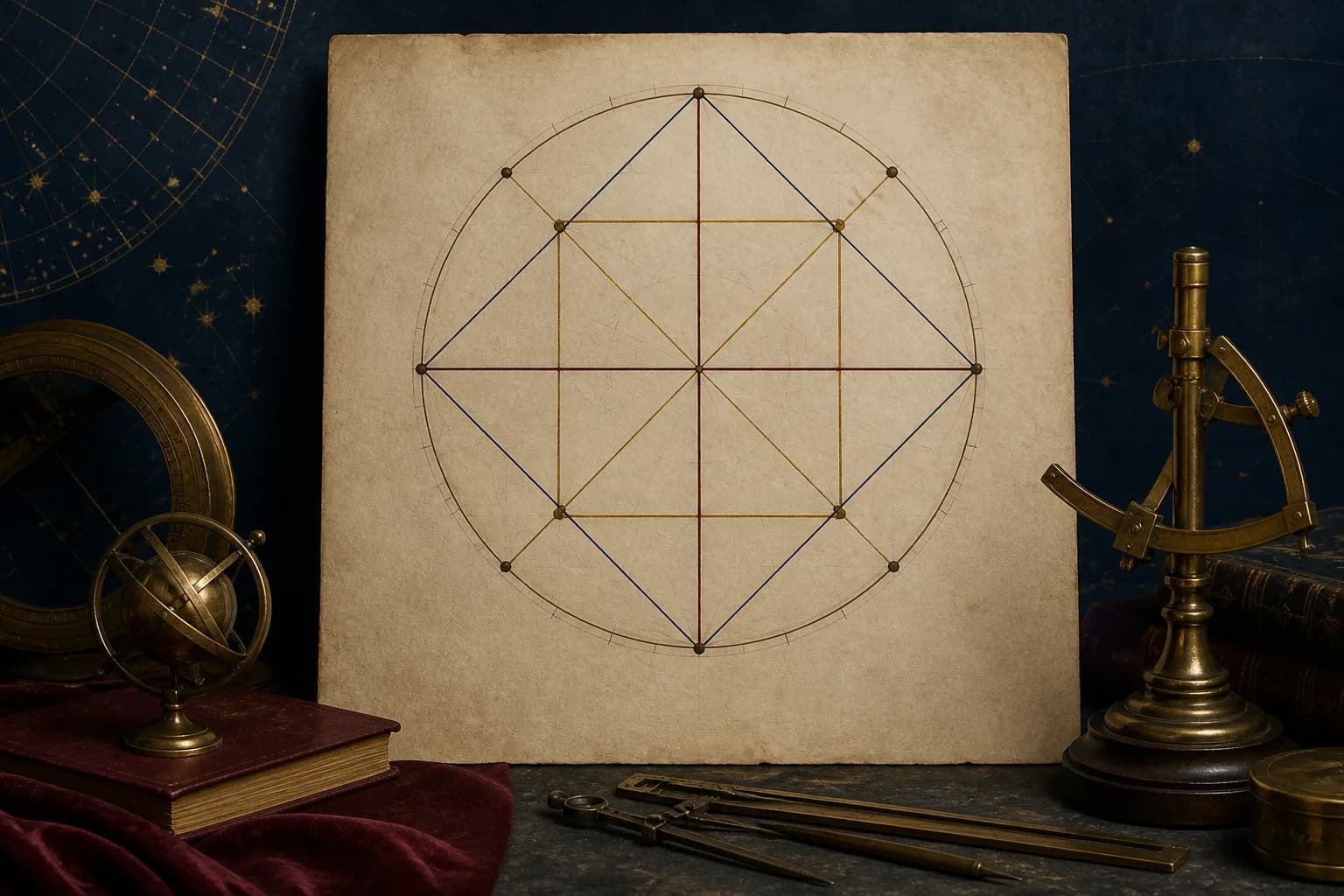
Conjunctions, oppositions, squares, trines, and sextiles are not an arbitrary list of fortunate and unfortunate angles. They arise from simple divisions of a 360-degree circle: halves produce 180 degrees, thirds 120, quarters 90, and sixths 60.
An aspect is a way of seeing
The language of aspect is related to looking. Zodiacal signs in certain geometrical relations were said to “see” one another. Adjacent signs and signs five places apart do not divide the circle evenly and were traditionally described as averse or unable to see.
Ptolemy discussed opposition, trine, square, and sextile. A conjunction is technically two bodies occupying the same region rather than two signs exchanging a line of sight, but it is normally included among the major aspects in practice.
Geometry does not determine good and bad
Trines connect signs of the same element and form a stable triangle, so they are commonly described as harmonious. Squares connect more tense directions; oppositions place bodies face to face at the greatest separation.
Ease is not always beneficial, and tension is not always harmful. The same 120-degree geometry means something different for Venus and Jupiter than for Mars and Saturn. Geometry supplies a relationship; planets, signs, houses, and circumstances supply content.
Orbs turn exact angles into ranges
Real charts rarely contain only exact integer angles. An orb admits positions near the target angle. Traditions vary over how wide it should be, whether the Sun and Moon receive more latitude, and whether an applying aspect deserves greater emphasis than a separating one.
A report that states the actual angular distance and chosen orb is more reproducible than one that merely says “there is a square.”
Applying and separating aspects add another distinction
Two planets near the same target angle may be moving toward exactness or away from it. Many traditions distinguish an applying aspect from a separating one, but the rule depends on planetary speed and the frame used. A static chart image can hide this information.
Before assigning a strong interpretation, record the two longitudes, exact separation, chosen orb, and whether the faster body is applying. This small audit makes it possible to compare software results and prevents a wide, separating contact from being discussed as though it were exact. Geometry provides a disciplined starting point; the interpretive weight remains a methodological choice.
Continue with the observed motion of wandering planets and the coordinate differences among constellations, signs, and the zodiac.
References
Related articles
Origins of Symbols · History of Astrology
Why Birth Charts Differ by Location at the Same Moment
Planetary longitudes remain almost identical, but every location has a different horizon and meridian, changing the Ascendant and houses.
Origins of Symbols · History of Astrology
The Twelve Astrological Houses Did Not Develop All at Once
House topics and methods for dividing the local sky are separate historical problems. Astrology developed several incompatible house systems.
Origins of Symbols · History of Astrology
Why Were Planets Called “Wandering Stars”?
Planets were called wandering stars because they move against the fixed-star background. Their apparent paths also explain the term retrograde motion.