
Origins of Symbols · History of Astrology
12 Zodiac Signs vs. 13 Constellations
- Author
- Editorial Board, Orphic Meridian Association
- Date
- 2025-05-28
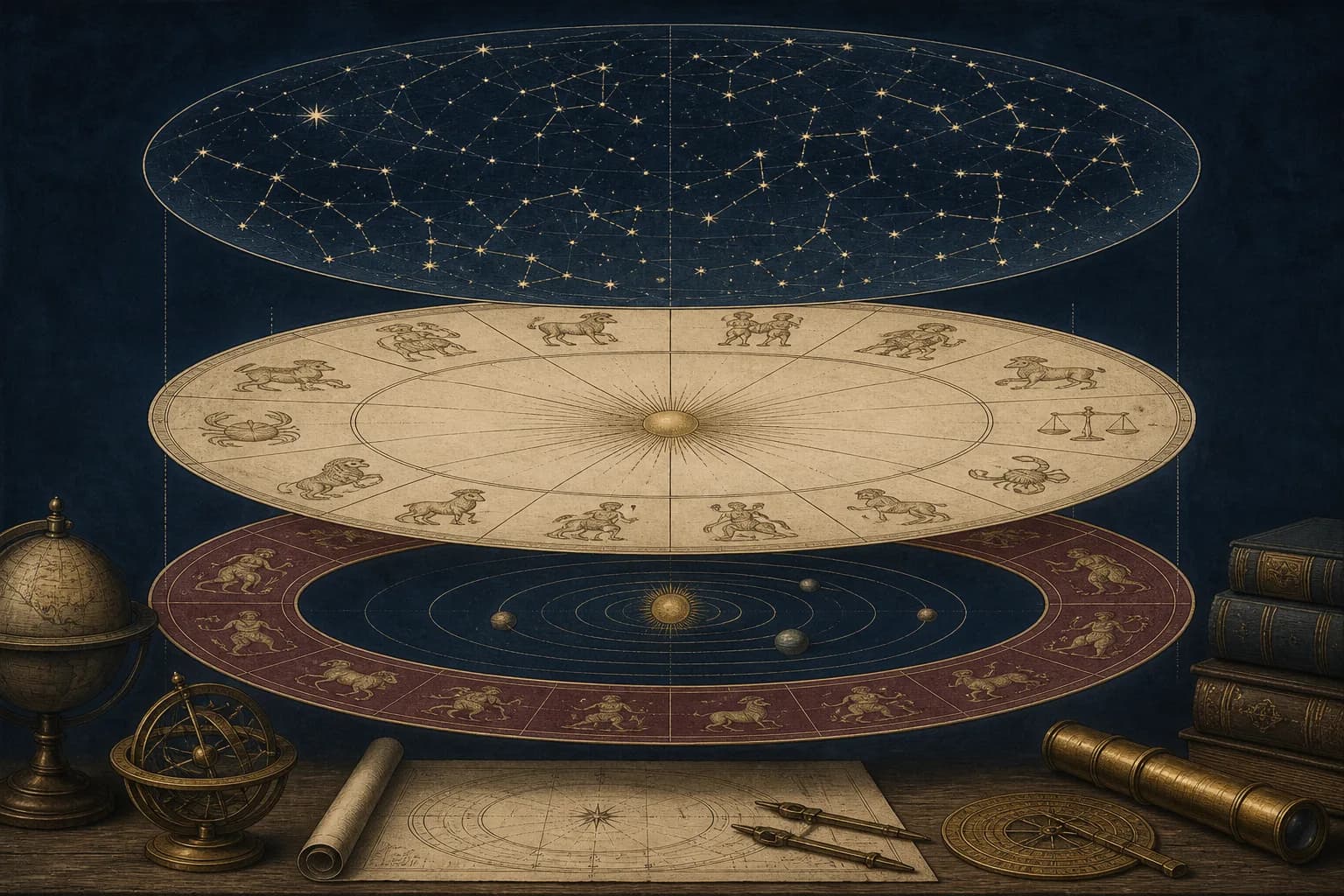
The zodiac contains twelve equal astrological signs, but the Sun's path crosses thirteen constellations under modern astronomical boundaries. The zodiacal belt is something else again: a band of sky around the ecliptic. These systems overlap, but they do not share the same borders or answer the same question.
The short answer
- Zodiac signs are twelve equal sections of ecliptic longitude, each thirty degrees wide.
- Zodiac constellations are irregular astronomical regions. The Sun crosses thirteen of them under the modern IAU map, including Ophiuchus.
- The ecliptic is the Sun's apparent annual path through the sky.
- The zodiacal belt is the wider corridor around the ecliptic where the Moon and visible planets are usually found.
Constellations are mapped regions
Modern astronomy divides the whole sky into eighty-eight constellations. Every point belongs to one of these irregular regions, whose areas are unequal. Familiar stick figures are cultural patterns drawn between bright stars; official boundaries provide a standardized way to locate celestial objects.
The Sun's apparent path crosses constellations of different widths. It also crosses Ophiuchus, which is not part of the traditional twelve-sign sequence. There is no contradiction: a set of sky regions and a set of equal coordinate intervals answer different questions.
Signs are twelve equal intervals
Astrological signs divide ecliptic longitude into twelve sections of exactly thirty degrees. The tropical zodiac begins at the March equinox. Sidereal systems use a stellar reference and a precessional offset. Neither expands a sign because its namesake constellation covers more sky.
The names preserve an old relationship with constellations, but shared names do not create shared borders. Constellations cover the celestial sphere; signs divide one circle.
The twelve signs and thirteen ecliptic constellations
The twelve signs are Aries, Taurus, Gemini, Cancer, Leo, Virgo, Libra, Scorpio, Sagittarius, Capricorn, Aquarius, and Pisces. Every sign occupies exactly thirty degrees, so twelve signs complete the 360-degree circle.
The thirteen constellations commonly counted along the ecliptic are Pisces, Aries, Taurus, Gemini, Cancer, Leo, Virgo, Libra, Scorpius, Ophiuchus, Sagittarius, Capricornus, and Aquarius. Their widths are unequal, and their Latin astronomical names do not always match the everyday English form used for the corresponding sign.
Ophiuchus appears in the constellation list because the ecliptic passes through its IAU-defined region. It does not create a thirteenth tropical sign: the sign system is a twelve-part longitude scale, not a list of every constellation crossed by the Sun.
Why zodiac date lists disagree
Popular sign dates usually describe approximate tropical-zodiac boundaries, not the dates when the Sun occupies an IAU constellation. The exact moment of a tropical ingress can shift slightly with year and time zone. Astronomical constellation dates differ much more because the regions are unequal and the Sun does not spend one month in each.
A list that gives every constellation an equal month has combined two different systems. Before using a date table, check whether it describes tropical signs, a sidereal zodiac, or the Sun's passage through modern constellation boundaries.
The zodiacal belt is a corridor
The Sun defines the ecliptic, while the Moon and planets usually appear near it because their orbital planes are only moderately inclined. The zodiacal belt is the band of sky around that central line in which these bodies are commonly found. It has width; the ecliptic itself is a line.
Identify the map before interpreting it
In an astrological chart, “Mars in Leo” usually means that Mars occupies the longitude interval called Leo, not necessarily that it lies inside the IAU constellation boundary. A more explicit report might say “Mars in tropical Leo.”
Precision does not drain symbols of meaning. It tells readers which map is being used and lets someone else reproduce the claim.
A quick test for ambiguous claims
When a diagram or article uses a zodiac name, look for its units and boundaries. Degrees measured from an equinox indicate a tropical sign system. A stated precessional offset suggests a sidereal system. Irregular borders assigned by the IAU indicate constellations. A shaded band around the Sun's path indicates the zodiacal belt.
These distinctions also prevent a common category mistake: the fact that the Sun crosses thirteen astronomical constellations along the ecliptic does not insert a thirteenth equal interval into a twelve-part coordinate. Conversely, a twelve-sign chart does not describe every constellation touched by the Sun. Each model includes only what it was built to represent.
Read why the zodiac starts with Aries, how planets became the wandering stars, why birth charts differ by location, and how the twelve astrological houses developed.
References
Related articles
Origins of Symbols · History of Astrology
Why Birth Charts Differ by Location at the Same Moment
Planetary longitudes remain almost identical, but every location has a different horizon and meridian, changing the Ascendant and houses.
Origins of Symbols · History of Astrology
Why Astrological Aspects Use 0°, 60°, 90°, 120°, and 180°
The major aspects come from simple divisions of a circle. Their geometry describes a relationship, while planets and context supply its content.
Origins of Symbols · History of Astrology
The Twelve Astrological Houses Did Not Develop All at Once
House topics and methods for dividing the local sky are separate historical problems. Astrology developed several incompatible house systems.