
Origins of Symbols · History of Astrology
The Twelve Astrological Houses Did Not Develop All at Once
- Author
- Editorial Board, Orphic Meridian Association
- Date
- 2025-07-09
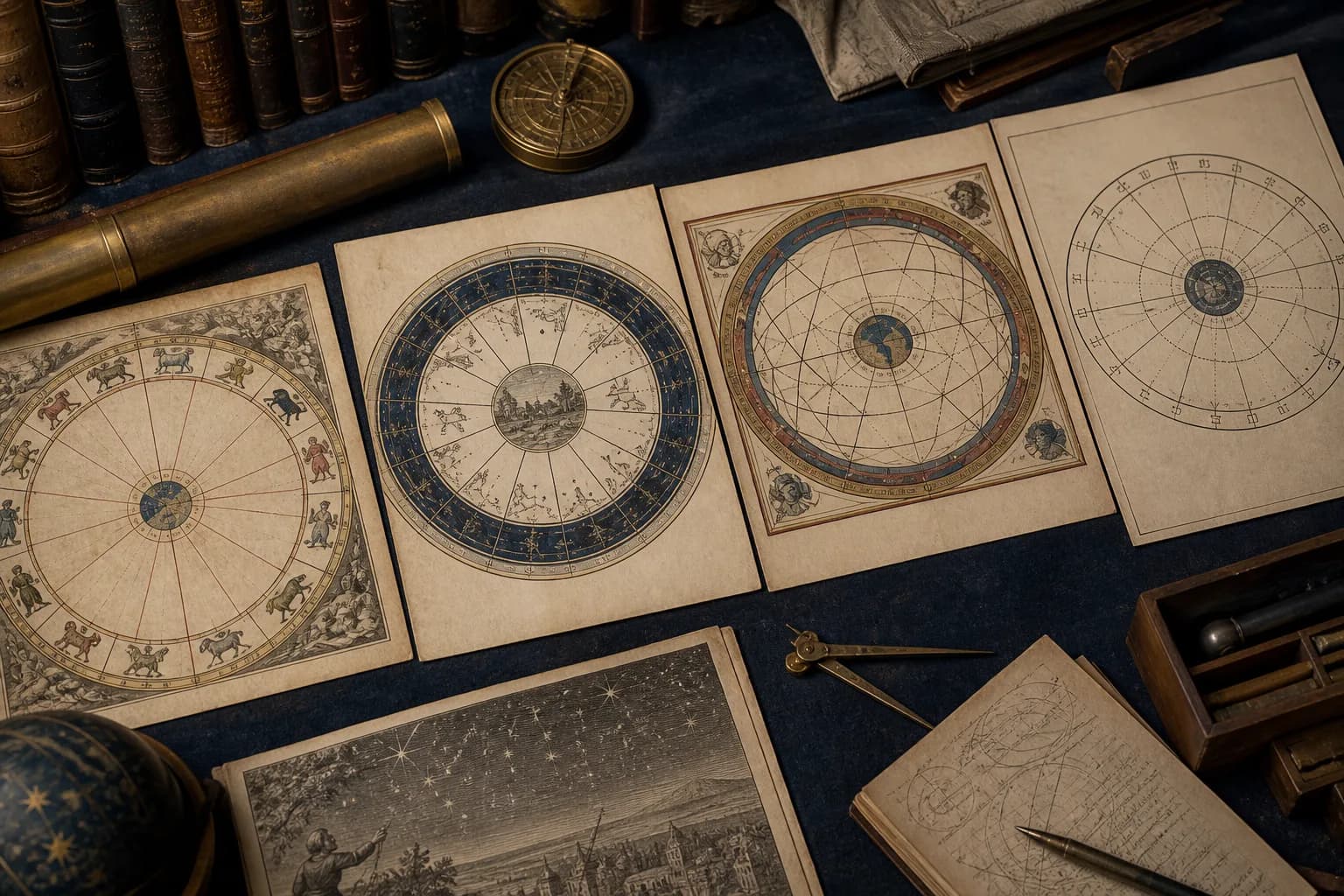
The twelve houses are often taught as a finished table of life topics. Historical sources show a longer process: topics, names, angular relationships, and calculation methods were not fixed by one author at one moment.
Places begin with the local horizon
The eastern rising point, western setting point, upper culmination, and lower culmination are four conspicuous directions in the local sky. Classical astrologers organized charts around these angles and the places that followed, preceded, or declined from them.
Greek topos means “place.” Older names such as Good Spirit, Bad Spirit, Goddess, and Gate of Hades overlap with later life topics without matching a modern keyword list word for word.
Topics and divisions are separate questions
Whole-sign houses make the entire rising sign the first house and the next sign the second. Equal houses begin at the ascending degree and measure thirty degrees each. Quadrant systems further divide arcs between angles using space, time, or both; Placidus and Regiomontanus are familiar examples.
Two astrologers may agree that the tenth house concerns public standing while calculating its boundary differently. A planet can therefore change houses between systems without any software error. Each algorithm answers a different geometrical question.
High latitudes expose the differences
Near the polar circles, some signs remain above or below the horizon for long periods. Certain time-based systems become extremely unequal or fail to produce ordinary cusps, while whole-sign houses can still be assigned. Geography is therefore a practical part of system choice.
Record the method before interpreting
A reproducible chart should identify birth time, place, time zone, zodiac, and house system. If a conclusion depends entirely on a planet crossing a disputed cusp, its certainty should be reduced.
Use one system consistently before comparing another on the same cases. Stable interpretations across systems carry different evidential weight from claims produced only by a movable boundary.
Compare systems without moving the goalposts
Choose several charts whose birth data are well documented and calculate them under two named systems. Record only the planets that actually change houses, then compare how much of the interpretation depends on those changes. This is more informative than debating systems through isolated success stories.
It also helps separate a house topic from a cusp algorithm. A reader may retain a historical understanding of the tenth place while testing whole-sign and quadrant boundaries. If a conclusion survives both, say so. If it appears only under one calculation, name that dependency rather than silently selecting the chart that best fits a biography.
See why the same moment produces different local charts and how major aspects arise from circle division.
References
Related articles
Origins of Symbols · History of Astrology
Why Birth Charts Differ by Location at the Same Moment
Planetary longitudes remain almost identical, but every location has a different horizon and meridian, changing the Ascendant and houses.
Origins of Symbols · History of Astrology
Why Astrological Aspects Use 0°, 60°, 90°, 120°, and 180°
The major aspects come from simple divisions of a circle. Their geometry describes a relationship, while planets and context supply its content.
Origins of Symbols · History of Astrology
Why Were Planets Called “Wandering Stars”?
Planets were called wandering stars because they move against the fixed-star background. Their apparent paths also explain the term retrograde motion.