
Origins of Symbols · Zhouyi Texts
The Zhouyi, Tuan, and Xiang Come from Different Textual Layers
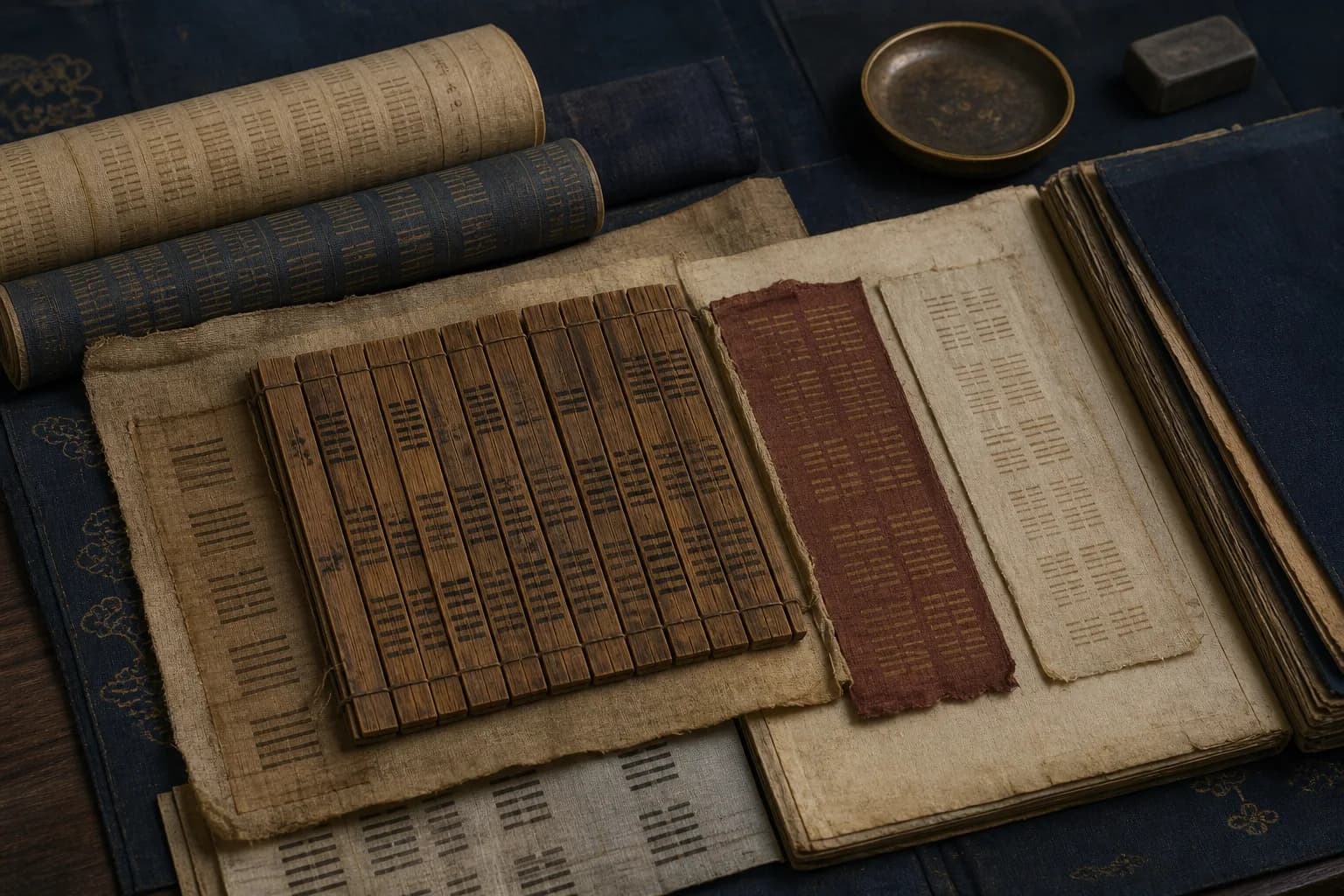
- Author
- Editorial Board, Orphic Meridian Association
- Date
- 2026-08-12
In a received edition, a hexagram statement, “Tuan says,” “Xiang says,” and six line statements can appear as one continuous unit. Modern textual study usually distinguishes earlier hexagram and line statements from commentaries formed around them later.
What belongs to the core text?
Hexagram figures, names, judgments, and line statements form the core. Their terse language preserves situations of sacrifice, war, marriage, travel, hunting, and political action. They are not a continuous philosophical essay but materials used in divination and repeatedly reinterpreted.
What does the Tuan do?
The Tuan interprets each hexagram name and judgment through upper and lower trigrams, firm and yielding positions, and the significance of timing. It organizes brief statements into broader moral and political arguments.
Reading it as the only literal meaning of the earlier words conceals the act of interpretation. Read the core first, then mark what the Tuan selects and adds.
The Xiang has two levels
The Great Xiang relates the two trigram images to an ethical action, often beginning “the noble person thus…” The Small Xiang comments on individual lines. Both shaped later thought while approaching the core text from their own interpretive horizon.
The Ten Wings are not one essay
Tradition groups Tuan, Xiang, Xici, Wenyan, Shuogua, Xugua, and Zagua as Ten Wings and attributes them to Confucius. Manuscripts, language, and intellectual layers have led modern scholars to view them as interpretive material formed over time, broadly from the Warring States into the early Han, with dates still debated.
Later does not mean unimportant. Distinguishing layers lets readers see both the early text and two millennia of interpretation.
Use separate notes or colors for core text, Wings, and later commentary, always recording the source. For structure, read how a hexagram is cast and why its lines run bottom to top.
Layered reading preserves disagreement
List people, actions, objects, and outcomes in the core statement before importing commentary. Then note which words the Tuan or Xiang selects and what concepts it adds. Finally compare one later commentator. The result is a visible history of interpretation rather than one seamless answer.
This avoids two errors: presenting a later moral reading as the only original meaning, or discarding it merely because it is later. A source can be historically secondary and culturally decisive at the same time.
References
Related articles
Origins of Symbols · Zhouyi Texts
Why the Same Zhouyi Passage Reads Differently in Translation
Check the source text, textual layers, and choice of commentary before comparing wording. A useful comparison traces differences to evidence.
Origins of Symbols · Zhouyi Texts
The Same Sixty-Four Hexagrams, a Different Order at Mawangdui
The Mawangdui silk manuscript groups hexagrams by their component trigrams. A practical comparison separates ordering rules, textual differences, and claims about an editor’s intentions.
Origins of Symbols · Zhouyi Texts
Yarrow Stalk and Three-Coin Line Probabilities Compared
No. The common three-coin method distributes line values 1:3:3:1, while the received yarrow algorithm produces approximately 1:5:7:3.