
Origins of Symbols · Zhouyi Texts
Yarrow Stalk and Three-Coin Line Probabilities Compared
- Author
- Editorial Board, Orphic Meridian Association
- Date
- 2026-07-22
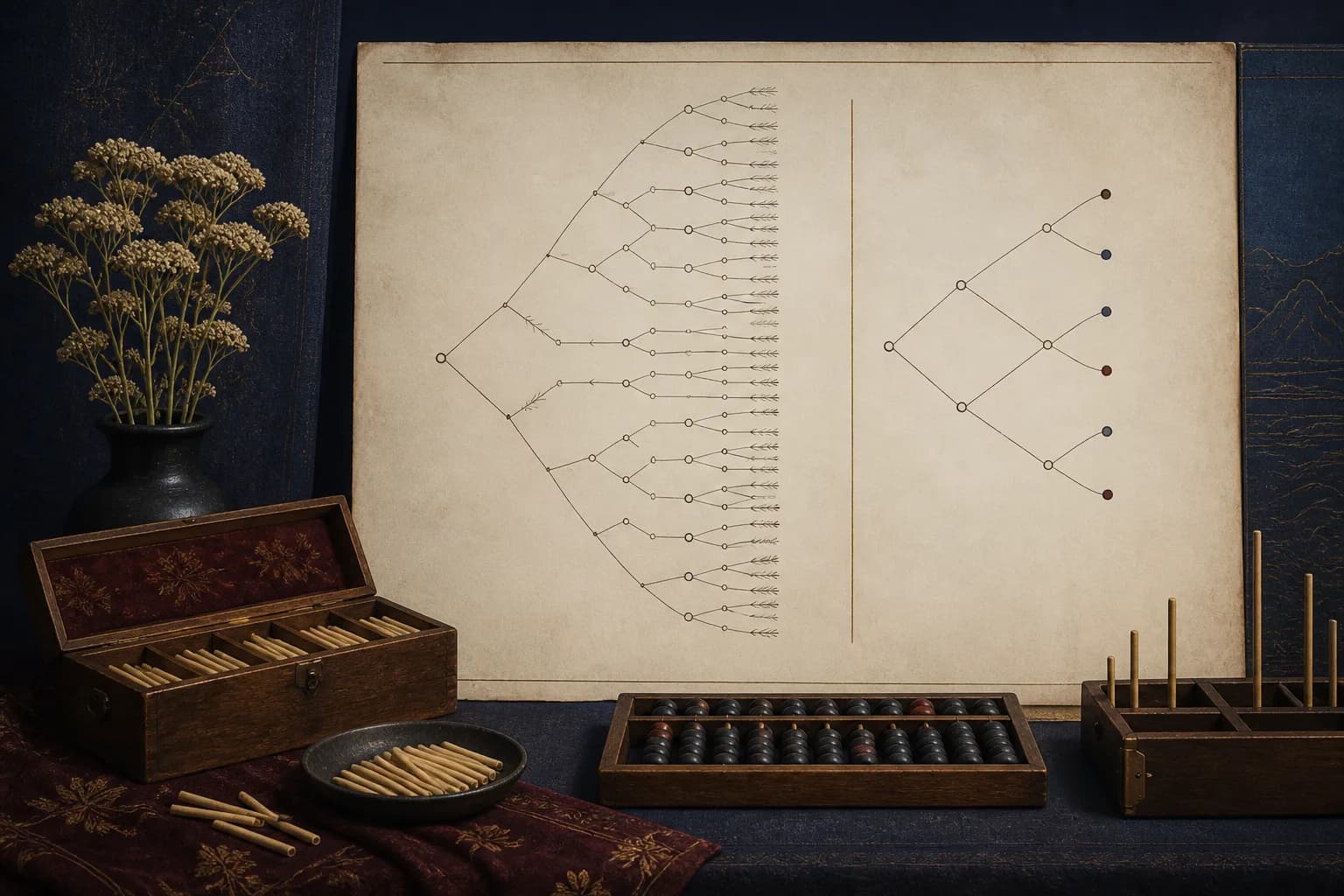
Yarrow stalks and three coins both produce six, seven, eight, and nine, but not at equal frequencies. Under common algorithms, coins distribute them 1:3:3:1; the received yarrow procedure approximately 1:5:7:3.
Why three coins produce 1:3:3:1
Three fair coins have eight equally likely face combinations. All alike occurs once at either extreme; two of one face and one of the other occurs in three arrangements each. Mapped to line values:
- old yin, six: 1/8;
- young yang, seven: 3/8;
- young yin, eight: 3/8;
- old yang, nine: 1/8.
Total yin and yang probabilities are equal, and old yin and old yang are symmetric.
Why yarrow is asymmetric
Each yarrow transformation divides, sets aside, counts by fours, and collects remainders. Branches do not carry equal weight. The common full derivation yields six at 1/16, seven at 5/16, eight at 7/16, and nine at 3/16.
Both methods give a changing-line probability of one quarter, but yarrow favors old yang over old yin. This is an algorithmic difference, not evidence that one process is more mystical or accurate.
Probability describes repeated trials, not the truth of one hexagram. Simplified yarrow methods and software can create still other distributions, so document the exact procedure and mapping.
Changing-line counts do not validate a reading
Further probabilities can be calculated for no changing lines, exactly one, or several. These figures describe repeated output from an algorithm. They do not show that a particular number of changes better matches a person's reality.
One cast also cannot reveal which procedure generated it. Probability is useful when auditing software, comparing long runs, or teaching how rules shape outcomes—not when assigning confidence to a single interpretation.
Read how both casting methods work and why lines are recorded upward.
References
Related articles
Origins of Symbols · Zhouyi Texts
How a Zhouyi Hexagram Is Cast with Yarrow Stalks or Three Coins
Both methods produce one line at a time as six, seven, eight, or nine. Six lines recorded from bottom to top form a hexagram.
Origins of Symbols · Zhouyi Texts
Why the Same Zhouyi Passage Reads Differently in Translation
Check the source text, textual layers, and choice of commentary before comparing wording. A useful comparison traces differences to evidence.
Origins of Symbols · Zhouyi Texts
The Same Sixty-Four Hexagrams, a Different Order at Mawangdui
The Mawangdui silk manuscript groups hexagrams by their component trigrams. A practical comparison separates ordering rules, textual differences, and claims about an editor’s intentions.