
Origins of Symbols · Zhouyi Texts
Why Zhouyi Hexagram Lines Are Read from the Bottom Up
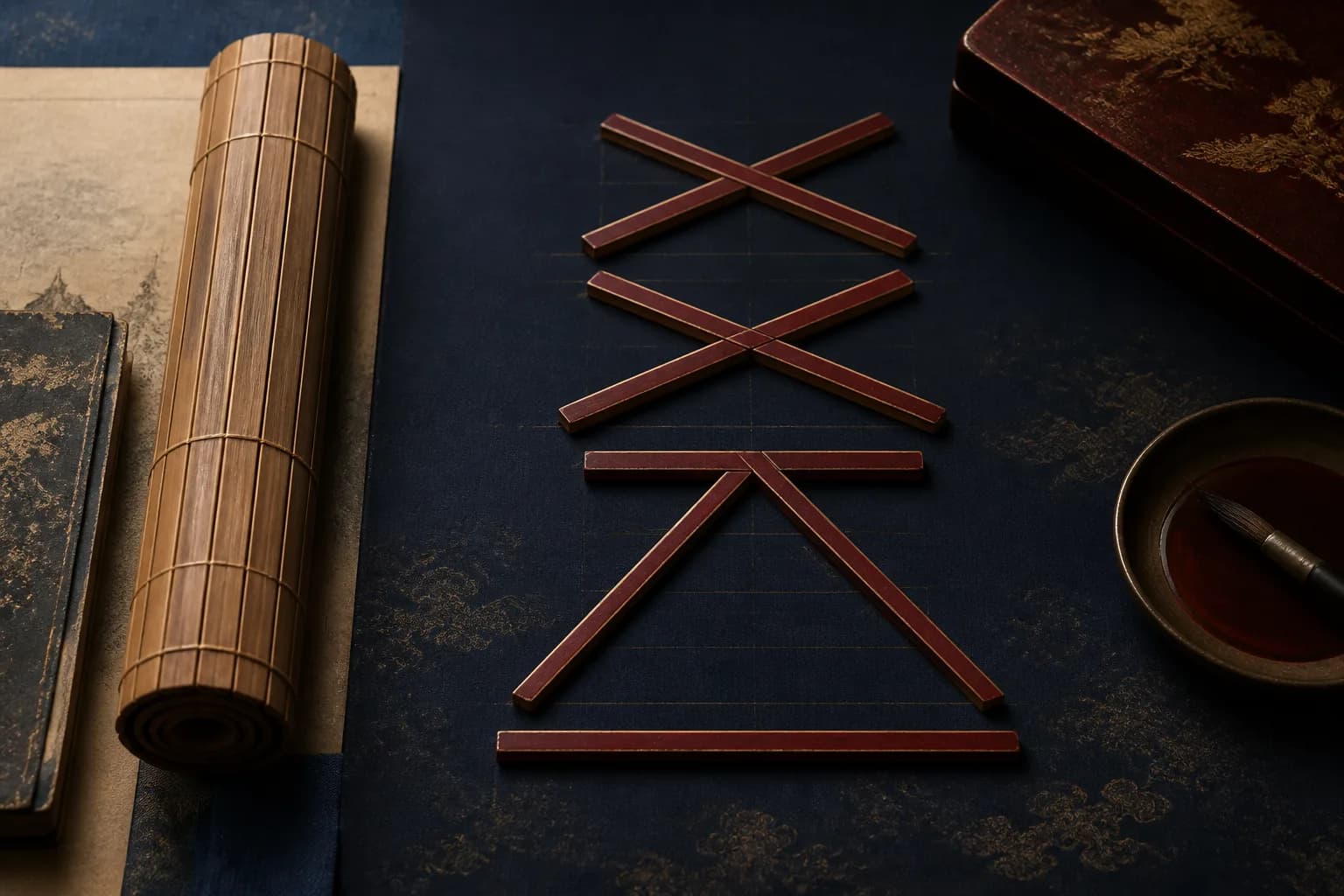
- Author
- Editorial Board, Orphic Meridian Association
- Date
- 2026-07-01
A hexagram is drawn and numbered from the bottom upward. The lowest is the initial line, the highest the top line, with second through fifth between them. Placing the first result at the top reverses the figure into another hexagram.
“Initial” is not simply “one”
Line statements say “initial nine” or “initial six” because the position begins a process. The highest is “top nine” or “top six,” marking an extreme or completion. Nine and six identify line quality; the position identifies its level.
The lower trigram forms first
Lines one through three make the lower trigram; four through top make the upper. Casting completes the lower figure before the upper. This spatial order also informs language of going, coming, rising, riding above, and supporting from below.
Position participates in interpretation
The same yang line does not occupy the same situation at the first and fifth positions. Initial positions often concern beginnings; top positions may concern completion, excess, or withdrawal. Second and fifth are central in their trigrams, while third and fourth meet at the boundary.
These are structures, not a fixed auspiciousness chart, and bottom-to-top order does not force every hexagram into a simple progress narrative.
Prepare six labeled spaces before casting and fill from the bottom, recording six, seven, eight, or nine as well as the line.
Order provides structure, not a guaranteed plot
The six positions are often described as movement from beginning through development to completion. That can be useful, but line statements may repeat a warning, reverse direction, or show that reaching the top has become excessive.
Treat position as one source of evidence alongside the wording, relations among lines, and upper and lower trigrams. The sequence tells us where a statement occurs; it should not replace the text with a generic progress story.
See how yarrow and coins generate the lines and how the Zhouyi's textual layers differ.
References
Related articles
Origins of Symbols · Zhouyi Texts
Why the Same Zhouyi Passage Reads Differently in Translation
Check the source text, textual layers, and choice of commentary before comparing wording. A useful comparison traces differences to evidence.
Origins of Symbols · Zhouyi Texts
The Same Sixty-Four Hexagrams, a Different Order at Mawangdui
The Mawangdui silk manuscript groups hexagrams by their component trigrams. A practical comparison separates ordering rules, textual differences, and claims about an editor’s intentions.
Origins of Symbols · Zhouyi Texts
The Zhouyi, Tuan, and Xiang Come from Different Textual Layers
Hexagram and line statements form an earlier textual layer; the Tuan, Xiang, and other Wings preserve later traditions of interpretation.