
Archaeology Notes · Runes
A New Faroese Runestone—and Why It Is Too Early to Translate It
- Author
- Editorial Board, Orphic Meridian Association
- Date
- 2026-08-07
In July 2026, the National Museum of the Faroe Islands found a stone with runic incisions during excavation at Sondum á Sandi on Sandoy. The stone lay in the floor of a building uncovered that summer. Runestones are rare in the islands, and the find quickly attracted attention.
What has been established
The museum announced the discovery on 22 July and identified its own team as the finders. It leads the excavation in collaboration with Aarhus University and Moesgaard Museum.
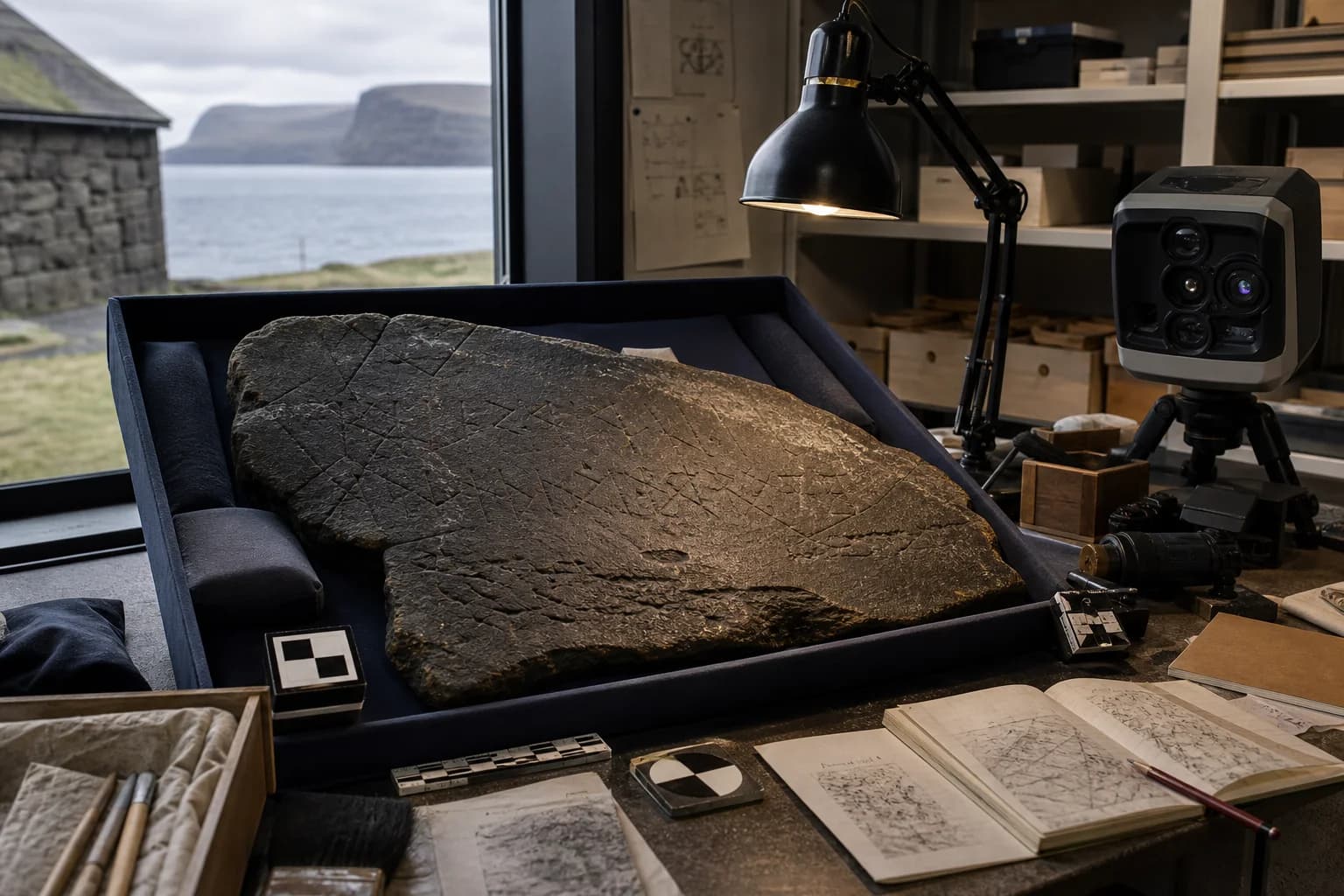
The newly exposed stone is fragile and had to be moved for conservation. The Faroese government later reported that it would be surveyed and 3D scanned, preserving a digital model and allowing marks to be examined under varied virtual lighting.
A preliminary reading is not a decipherment
Archaeologists believe that some characters may be recognizable and have requested further examination by a runologist. News reports have mentioned a tentative phrase resembling “here rests,” but this remains a possibility until letter forms, surface, and archaeological context have been studied together.
Not every visible line is necessarily writing. Breakage, tool marks, wear, and intentional inscription can overlap. Even if several characters are secure, missing sections may still prevent a reliable word or date.
Why 3D recording matters
Raking-light photography and a three-dimensional model can distinguish groove depth, examine crossing strokes, and preserve the surface before further handling and conservation. They do not decipher the text automatically, but they let specialists in different places discuss the same surface evidence.
The find is also a useful model for reading archaeological news: begin with the institution's confirmed context and conservation work, then keep preliminary readings separate from published conclusions. The decisive update should come from later archaeological and runological analysis.