
Origins of Symbols · History of Astrology
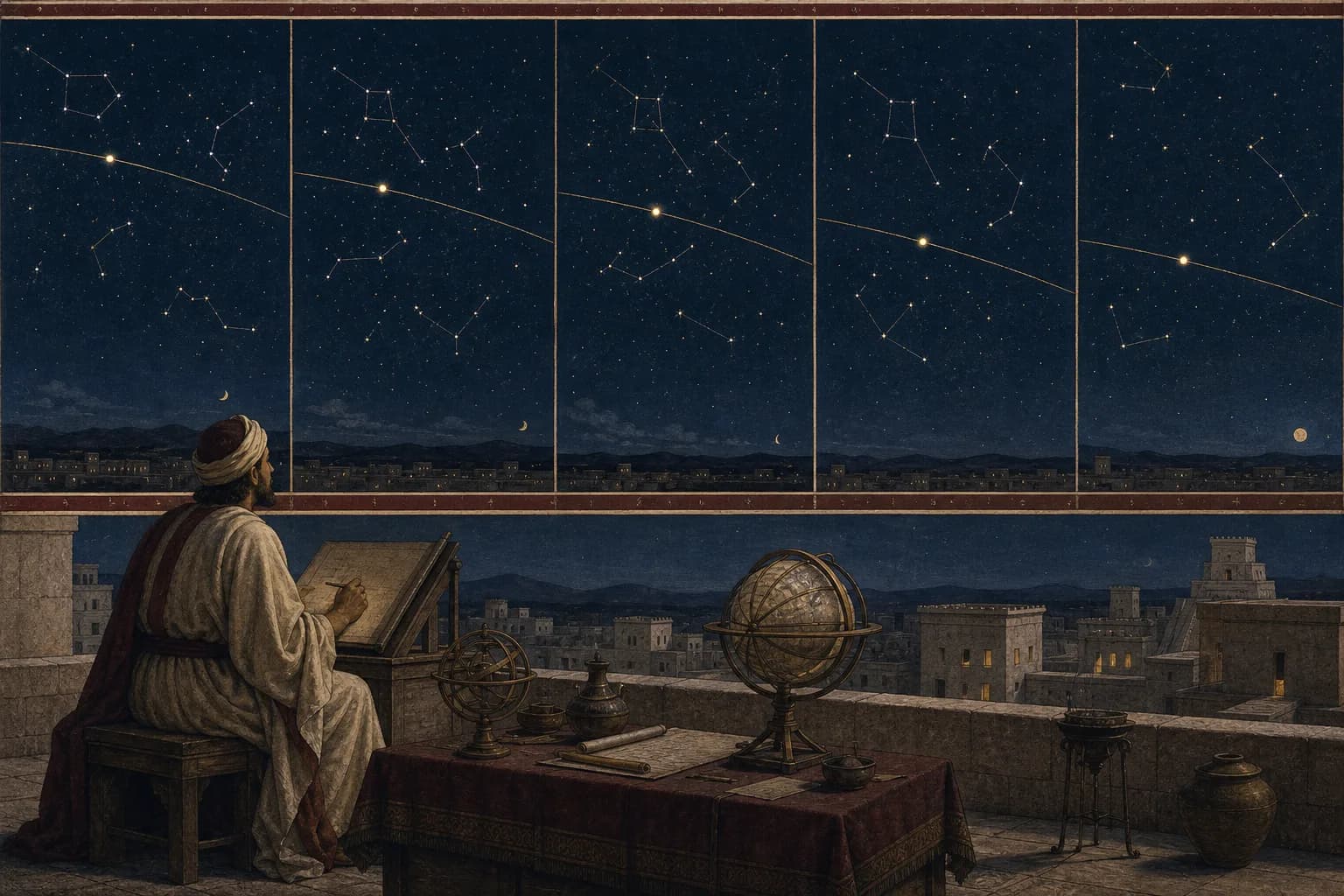
Why Were Planets Called “Wandering Stars”?
- Author
- Editorial Board, Orphic Meridian Association
- Date
- 2025-06-18
Planets were called “wandering stars” because, unlike the stars that keep stable patterns relative to one another, planets gradually change position against the stellar background. Greek planētēs means a wanderer. Classical astronomy counted the Sun, Moon, Mercury, Venus, Mars, Jupiter, and Saturn as seven such moving lights.
The movement requires repeated observation
Every visible object appears to rise and set during a night because Earth rotates. What distinguishes a planet is its gradual displacement among the constellations. Mark Mars on the same chart every few nights and its path along the zodiac becomes visible.
This requires dated, comparable records. Ancient astronomy and astrology shared that practical foundation: identify a body, record time and position, recognize cycles, and construct tables capable of predicting future positions.
Retrograde motion is apparent motion
An outer planet can appear to slow, stop, move backward, and then resume its usual direction. In a heliocentric model, Earth overtakes the slower outer planet on an inner orbit, changing the line of sight and producing a retrograde loop against the background stars.
Ancient models used deferents, epicycles, and other geometry to predict the same observation. Knowing the physical explanation does not invalidate retrograde as a descriptive, geocentric term. It does mean that a true astronomical observation should not be presented as proof of a causal effect on an unrelated event.
The seven classical planets are a historical category
The Sun and Moon belong to the classical list because it classifies visible motion. Modern astronomy defines planets through physical and orbital criteria: Earth enters the list, the Sun is a star, and the Moon a satellite.
When reading an older text, retain the question its vocabulary answered. Correcting it with a later definition can erase the actual history of observation.
Observation and interpretation are separate steps
Retrograde stations can be calculated precisely for a chosen geocentric frame. That precision describes apparent position; it does not by itself establish what a station means for communication, markets, health, or an individual decision. An astrological tradition may assign symbolic significance, but the interpretive rule should be named rather than presented as part of the astronomical measurement.
This separation improves historical reading as well. Ancient authors could observe and predict planetary cycles without sharing a modern physical model. We can evaluate their positional work, cosmology, and symbolism as related but distinct achievements instead of accepting or rejecting all three together.
Continue with constellations, signs, and the zodiacal belt or the geometry behind major astrological aspects.
References
Related articles
Origins of Symbols · History of Astrology
Why Birth Charts Differ by Location at the Same Moment
Planetary longitudes remain almost identical, but every location has a different horizon and meridian, changing the Ascendant and houses.
Origins of Symbols · History of Astrology
Why Astrological Aspects Use 0°, 60°, 90°, 120°, and 180°
The major aspects come from simple divisions of a circle. Their geometry describes a relationship, while planets and context supply its content.
Origins of Symbols · History of Astrology
The Twelve Astrological Houses Did Not Develop All at Once
House topics and methods for dividing the local sky are separate historical problems. Astrology developed several incompatible house systems.