
Origins of Symbols · Zhouyi Texts
FDL-026
How a Zhouyi Hexagram Is Cast with Yarrow Stalks or Three Coins
- Author
- Editorial Board, Orphic Meridian Association
- Date
- 2026-06-10
- Reading time
- 3 min
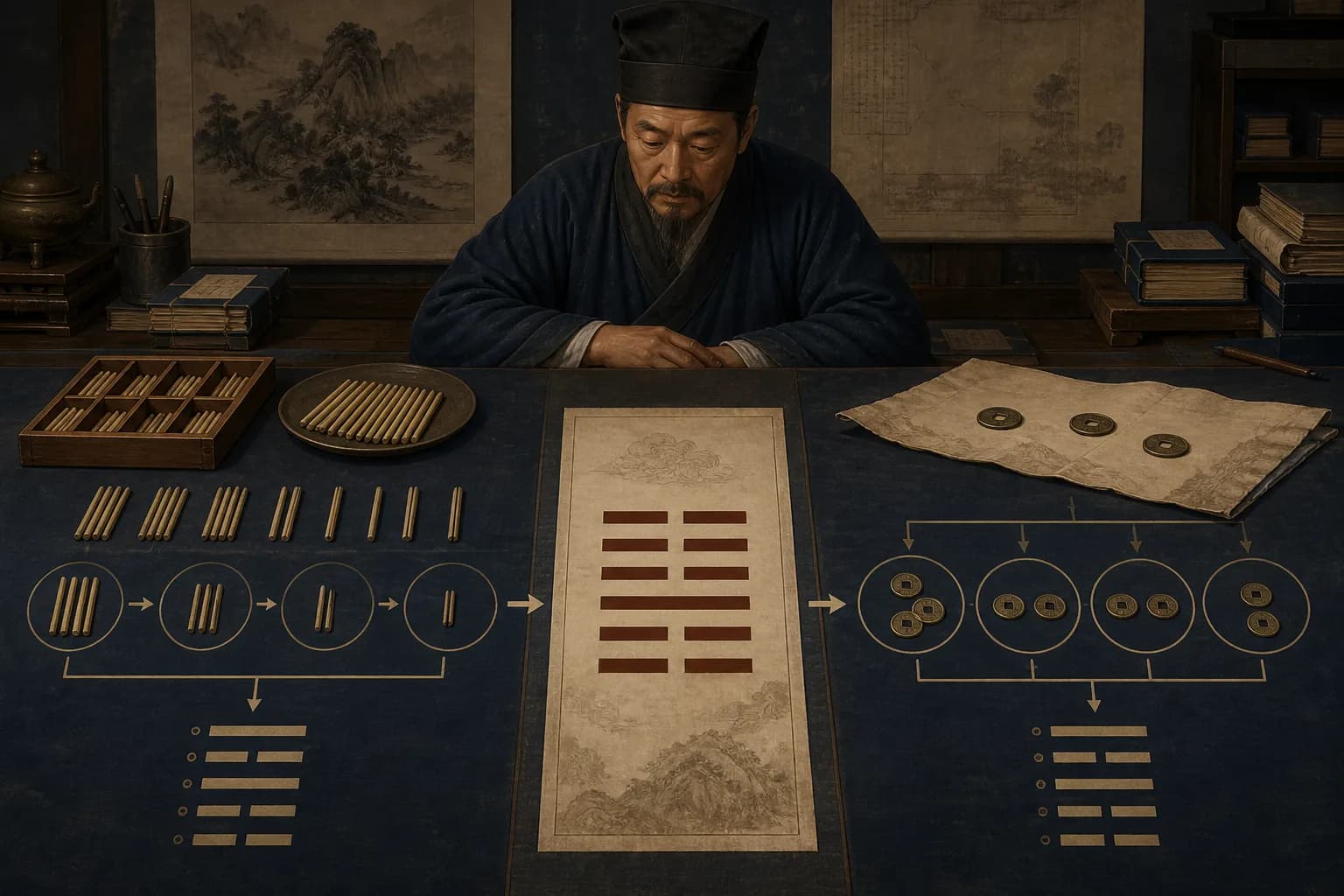
Neither yarrow stalks nor three coins produces a complete hexagram in one action. Each operation generates one line. Repeating it six times and recording from bottom to top constructs the six-line figure.
Four numbers preserve more than broken and solid lines
Six is old yin, seven young yang, eight young yin, and nine old yang. Seven and nine are drawn solid; six and eight broken. Six and nine are changing lines that reverse in the relating hexagram.
Record the complete number sequence. Drawing only yin and yang loses which lines changed.
Yarrow requires three transformations per line
The Xici states that the Great Expansion has fifty stalks and forty-nine are used. In the received procedure, forty-nine stalks are divided, one set aside, counted by fours, and the remainders collected. Three transformations produce one line; a hexagram requires eighteen.
Commentators debated the passage and procedure. Today's “yarrow method” is a received reconstruction through later commentary, not a modern instruction sheet attached to the earliest text.
Three coins map sums to line values
Assign values to the two faces, toss three coins, and add them to obtain six through nine. Conventions may reverse which face receives two or three, but the rule must be fixed before casting.
Coins are faster, not inherently less legitimate. Their probability distribution differs from the received yarrow procedure, while neither distribution measures the truth of one reading.
Casting supplies a textual entry point; it does not clarify a vague question or make a decision for the user.
Record enough to reconstruct the cast
Write the question and method before beginning. For coins, record which face receives which value. For yarrow, identify the exact procedure rather than using “traditional” as a substitute for instructions. Enter every line value in order and preserve both primary and relating hexagrams.
Electronic tools require the same transparency. A program may simulate equal four-way selection, coin probabilities, or yarrow probabilities. The screen can look identical while the underlying distribution differs.
Next read why lines are recorded bottom to top and how yarrow and coin probabilities differ.