
Origins of Symbols · Runic History
FDL-014
Elder Futhark, Younger Futhark, and Anglo-Saxon Runes Compared
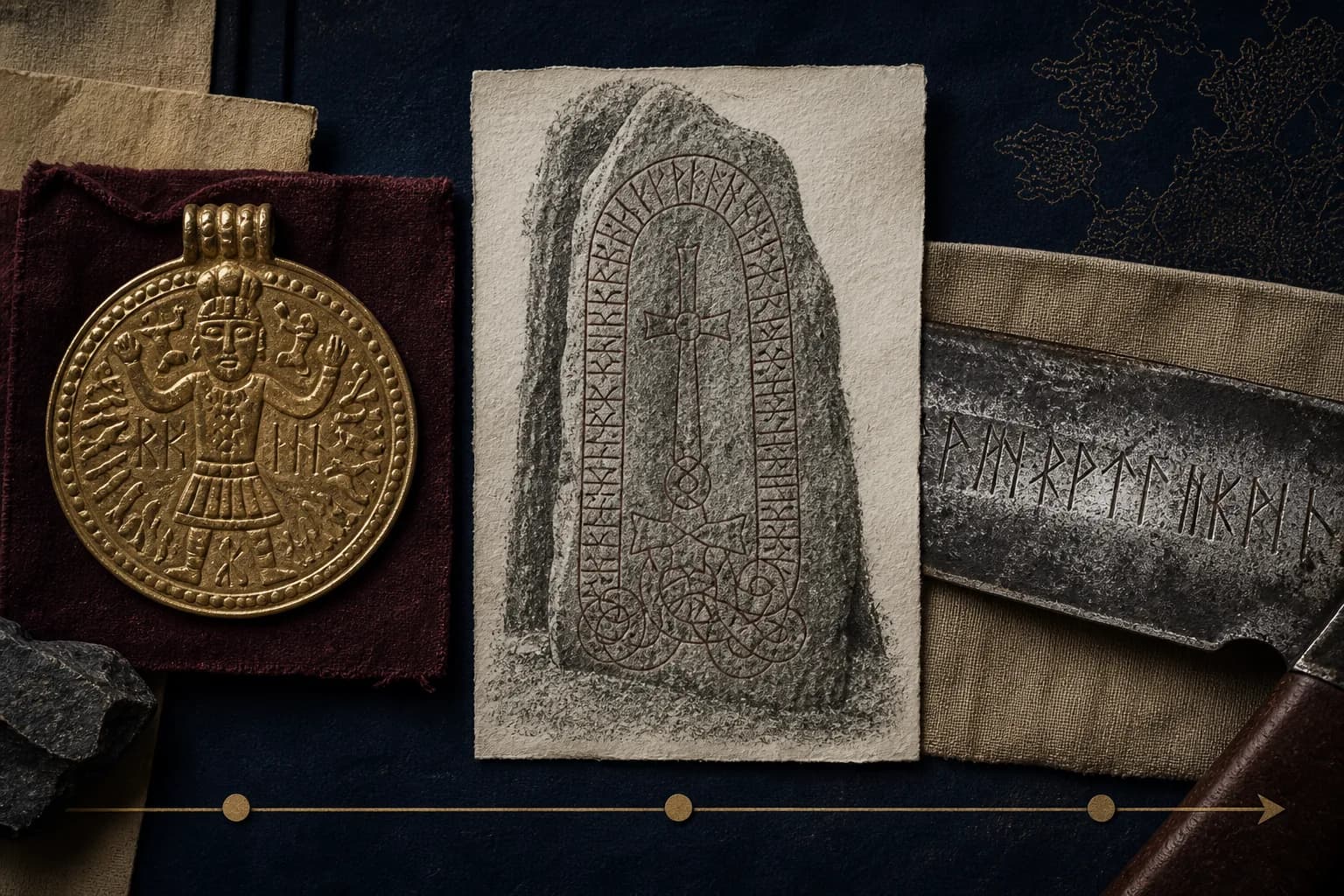
- Author
- Editorial Board, Orphic Meridian Association
- Date
- 2025-10-01
- Reading time
- 3 min
Elder Futhark, Younger Futhark, and Anglo-Frisian Futhorc are not simply an old version, a simplified version, and an English font. They developed amid different sound changes and writing needs.
Elder Futhark has twenty-four characters
Elder Futhark is the earliest extensively attested rune row, used mainly for Germanic inscriptions from roughly the second to eighth centuries. Futhark is formed from its first six sound values, as alphabet comes from alpha and beta.
Its inscriptions are often short and its forms vary. A modern printed chart should not be mistaken for a uniform historical typeface.
Younger Futhark reduced the inventory
Viking Age Younger Futhark usually has sixteen basic characters. Old Norse sound distinctions increased while the number of runes decreased, leaving one rune to represent multiple sounds. Context became essential for reading.
Long-branch and short-twig forms add further variation. A product that silently restores Younger Futhark to twenty-four pieces has mixed systems.
Futhorc expanded for new sounds
In England and Frisia, the row expanded to twenty-eight, thirty-three, or other counts. Its name changed to futhorc, reflecting the altered early sound values. The Thames scramasax in the British Museum carries a complete sequence important to the study of English runes.
Identify the row before using it
Before transliterating a name, examining an inscription, or building a symbolic method, state the rune row and period. Similar-looking characters may differ in name or sound, and a missing sign should not be borrowed from another row without explanation.
A “complete rune set” is always complete for something
A twenty-four-piece set is complete for the normalized Elder Futhark row, not for every runic inscription. A sixteen-piece set may be appropriate to Younger Futhark, while an English inscription may require signs from expanded Futhorc. Completeness depends on language and period.
This is a practical test for reproductions and jewelry. If an object is advertised as Viking Age but uses the full twenty-four Elder Futhark sequence, ask for its model, date, and transliteration. The combination may be a conscious modern design, but it should not be mistaken for an ordinary Viking Age spelling system.
Next read how rune poems preserve names and which names are reconstructed.