
Exhibitions and Research · Tarot
The Morgan Places Renaissance Tarot beside Modern Art
- Author
- Editorial Board, Orphic Meridian Association
- Date
- 2026-07-08
- Reading time
- 4 min
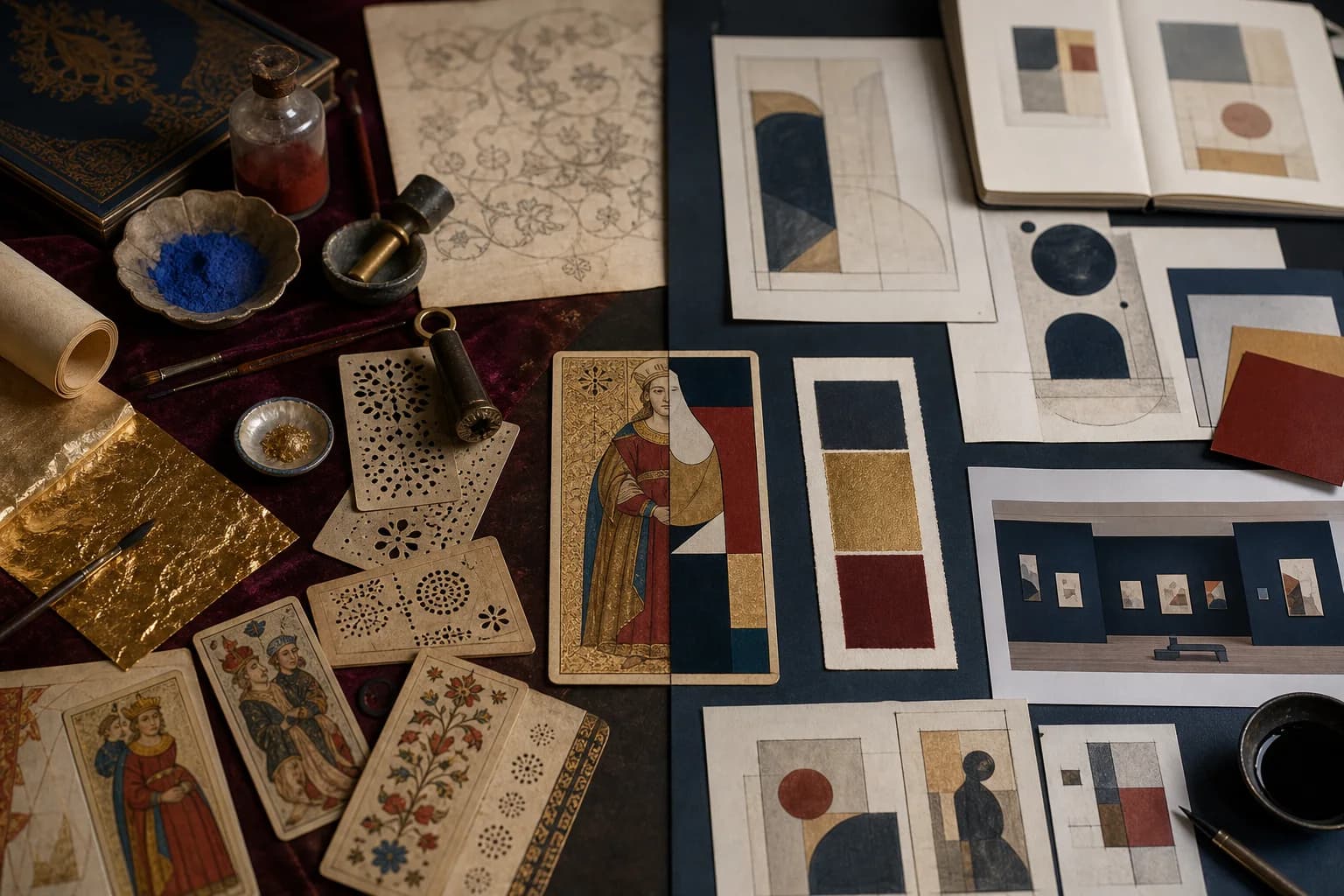
The Morgan Library & Museum opened Tarot! Renaissance Symbols, Modern Visions in New York on 26 June 2026. Running through 4 October, it is divided between fifteenth-century Italian court cards and the ways twentieth- and twenty-first-century artists have reused tarot imagery.
Early tarot was first a game
The exhibition states plainly that tarot began as a courtly game of skill, not as a repository of occult secrets or a method of prediction. The Morgan's Visconti-Sforza cards anchor the early section, which reunites its figural cards with related examples from the Accademia Carrara in Bergamo.
The physical comparison matters. Scale, gold leaf, pigment, wear, and composition are harder to understand through standardized reproductions. The expense and court setting of the objects also explain why they differ from later mass-market decks.
Entering the modern section through 1909
The modern section uses the 1909 deck conceived by Arthur Edward Waite and illustrated by Pamela Colman Smith as one turning point, then follows tarot through Surrealism, contemporary art, and film.
This is not a straight survival from ancient divination into modern art. Each adaptation selects images, changes medium and audience, and assigns new interpretive work to the cards.
What the exhibition changes in a course outline
When game history, divinatory history, and artistic reception are compressed into one origin story, students can come away believing that today's 78-card structure and keywords have been stable since the fifteenth century.
A clearer course begins with a timeline: court culture shaped the early cards; eighteenth-century writers developed explicit divinatory theories; nineteenth-century occult groups added correspondence systems; twentieth-century decks and artists expanded their visual language.