Origins of Symbols · Runic History
FDL-013
Runes Are Not “Norse Tarot”
- Author
- Editorial Board, Orphic Meridian Association
- Date
- 2025-09-10
- Reading time
- 3 min
Calling runes “Norse tarot” is convenient marketing and poor history. Tarot developed from card games; runes were writing systems. Their materials, dates, social uses, and bodies of evidence are different.
Runes appear on many kinds of object
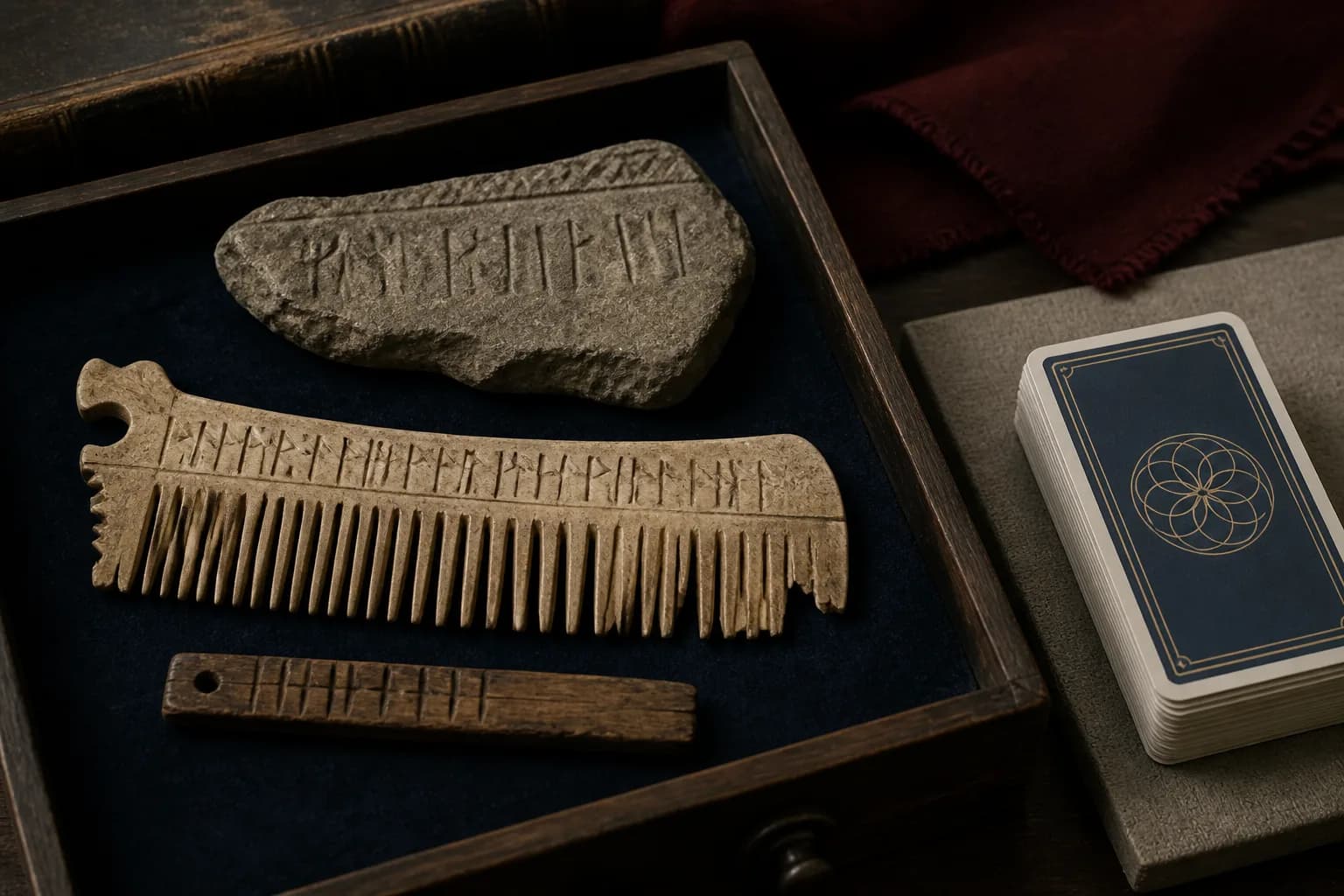
Surviving runes occur on stones, weapons, jewelry, bone, wood, combs, and ordinary possessions. An inscription may record a name, ownership, memorial, transaction, prayer, charm, or simply that someone carved it. Not every inscription is magical, and a character does not automatically possess a divinatory meaning.
The RuneS database organizes material from roughly AD 100 to 1500 by object, date, writing system, transliteration, and interpretation. That span alone shows why “the runic tradition” cannot mean one static set of twenty-four symbols.
Writing and divination are related only with care
Tacitus described Germanic lot-casting with marked wooden slips. He did not identify the marks as a documented runic row or provide individual meanings. The passage supports the existence of lot-casting, not an unbroken transmission of a modern twenty-four-rune method.
Medieval sources do connect runes with magic, protection, and poetic knowledge. Yet evidence that runes were used ritually is not the same as evidence that each rune carried a fixed predictive keyword.
Modern use can be explicit about its sources
A modern divination practice can deliberately use runic forms as symbols. It should identify the rune row, distinguish attested and reconstructed names, cite the rune poem used, and label additions made by modern authors.
A useful source table separates inscription, medieval document, linguistic reconstruction, and modern interpretation. All four may be studied; they do not provide the same kind of evidence.
Material context changes what an inscription can mean
A name carved on a comb, a memorial statement on stone, and a charm on an amulet should not be read under one universal symbolic key. Object, find location, date, language, and neighboring words constrain interpretation. Even a single rune may be a sound, abbreviation, ownership mark, or part of a damaged text.
Modern sets remove the signs from these contexts and turn them into portable tokens. That transformation is itself worth documenting. It creates a new practice with different affordances: random selection, repeated layouts, and personal reflection. Calling it modern does not dismiss it; it prevents archaeological evidence from being asked to support procedures it never records.
Continue with the differences among three rune rows and what rune poems can tell us.