Research Notes · Ogham
Bringing More Than Six Hundred Ogham Objects into One Corpus
- Author
- Editorial Board, Orphic Meridian Association
- Date
- 2025-05-21
- Reading time
- 4 min
Ogham survives far beyond a small group of famous Irish standing stones. Its traces are dispersed across museums, archaeological sites, portable objects, graffiti, and manuscripts. The OG(H)AM project, supported by Irish and UK research councils, aims to bring about 640 examples into one searchable digital corpus.
A corpus larger than the stone record
The project covers material from the probable fourth-century beginnings of the script to the threshold of its modern revival around 1850. It includes portable objects and manuscripts alongside monuments.
That scope challenges the shorthand definition of Ogham as twenty letters cut along a stone edge. When a script moves between stone, handheld objects, and the manuscript page, direction, form, and purpose change with it. Material outside Ireland—from Scotland, Wales, Man, England, and continental collections—accounts for roughly a third of the surviving corpus described by the project.
What a 3D model adds
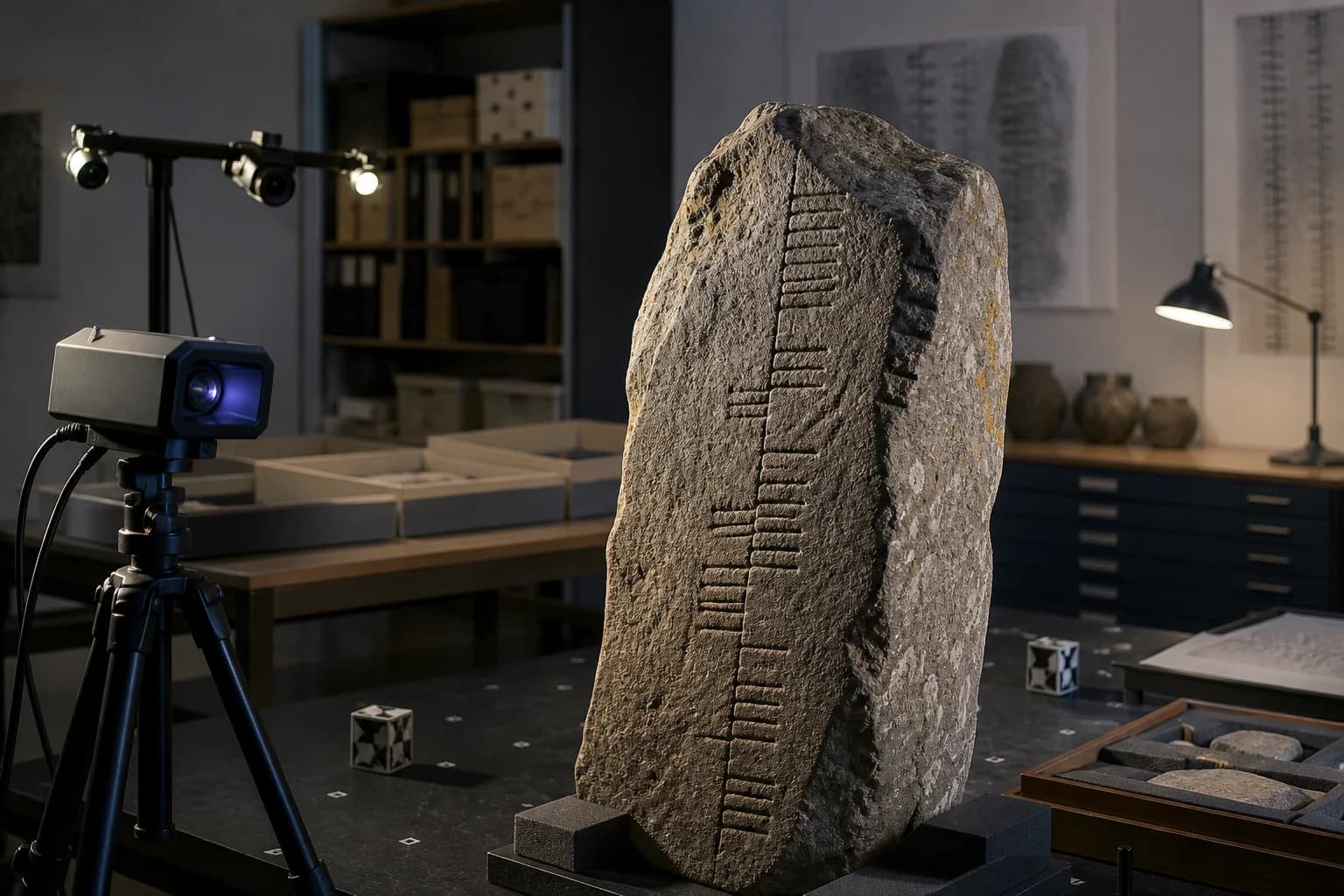
Printed corpora usually provide a transcription, drawing, and photograph. Weathered grooves, however, do not always remain legible under one fixed light. A 3D model lets a researcher vary illumination, compare groove depth, and examine how strokes relate to edges, breaks, and later alterations.
OG(H)AM builds on Ogham in 3D, which already covers about a quarter of surviving material. The expanded project aims to make 3D documentation available for nearly eighty percent of the corpus while linking inscriptions, supports, locations, and bibliography through open epigraphic standards.
Better access does not remove uncertainty
A model cannot decide whether every faint line is a letter or date an inscription by itself. Damage, relocation, and reuse still require archaeological context, historical records, and linguistic evidence.
The project therefore combines palaeography, corpus linguistics, groove analysis, and manuscript study. Its principal value for a general reader is not a new table of symbolic meanings, but direct access to the objects on which historical claims depend.
Why this matters for modern Ogham
Modern writing and divinatory practice often begin with standardized characters. The corpus makes it easier to separate three layers: what early inscriptions contain, how medieval texts expanded Ogham, and how modern practitioners interpret it.
When a modern meaning is presented as ancient, readers can ask whether it is supported by an inscription, a manuscript, or a recent reconstruction. That distinction leaves room for contemporary practice while making its sources visible.