
Origins of Symbols · Runic History
FDL-017
Where Did the “Blank Rune” Come From?
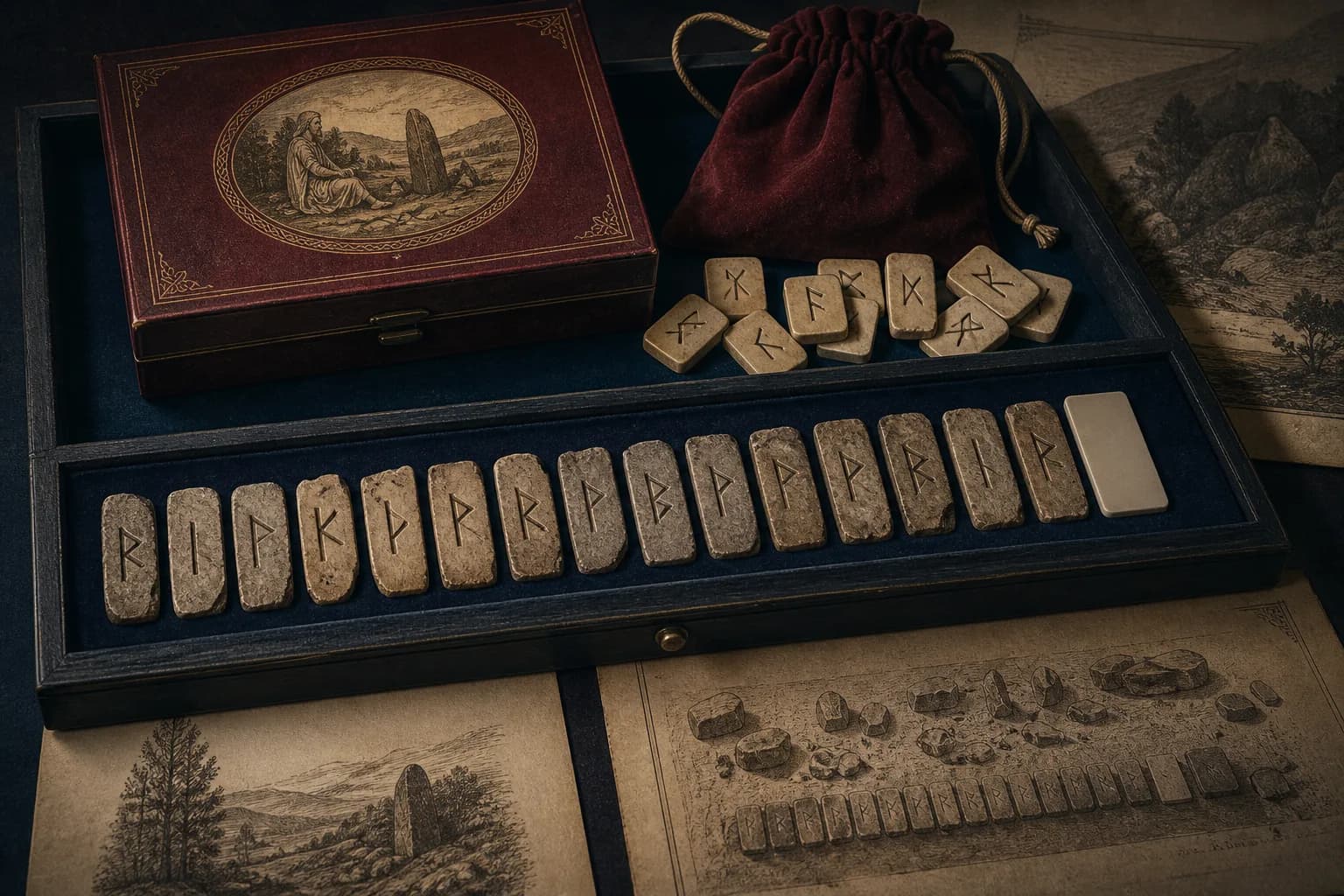
- Author
- Editorial Board, Orphic Meridian Association
- Date
- 2025-12-03
- Reading time
- 3 min
Many modern rune sets include an unmarked piece called the blank rune, Odin rune, or Wyrd. It does not belong to the twenty-four-character Elder Futhark and has no historical sound value, name, or position in the row.
Blank space is not an archaeological character
Historical inscriptions attest an ordered Elder Futhark sequence. An unmarked object may occur anywhere, but the absence of writing does not turn it into a letter.
The modern blank rune is generally traced to Ralph Blum's 1982 The Book of Runes and its commercial set. Blum associated it with the unknowable, fate, or divine will. That is a modern design decision, not the restoration of a lost rune.
Why it feels convincing
Blankness can represent what has not appeared, a refusal to answer, or an interruption. Drawing it creates a memorable pause. A real symbolic effect is easily mistaken for proof of ancient origin.
Usefulness and historical existence are different judgments. A modern innovation does not need an invented ancestry to be meaningful.
Keep it only with a clear label
Remove the blank piece when studying Elder Futhark as writing. In an explicitly modern reflection set, retain it only after deciding what it does and how it avoids becoming an escape from difficult interpretation.
“Wyrd” compresses a complex Old English idea into a blank object, while “Odin rune” lacks inscriptional support. “Modern blank rune” is the clearest name.
Test historical and practical claims separately
Ask first when the object entered a published set, who described it, and whether a historical row contains it. That settles the origin question without deciding whether a blank token is useful. Then ask what the token does in a present method and whether its rule can be applied consistently.
Keeping the questions separate prevents two common reactions: inventing antiquity to protect a valued practice, or dismissing every recent symbol as meaningless. A modern tool can be effective for pause and reflection while remaining a documented twentieth-century addition.
Read how rune names are reconstructed and which steps in casting runes on cloth are modern.