
Origins of Symbols · Tarot History
FDL-001
Tarot Began as a Card Game, Not a Divination System
- Author
- Editorial Board, Orphic Meridian Association
- Date
- 2025-01-01
- Reading time
- 4 min
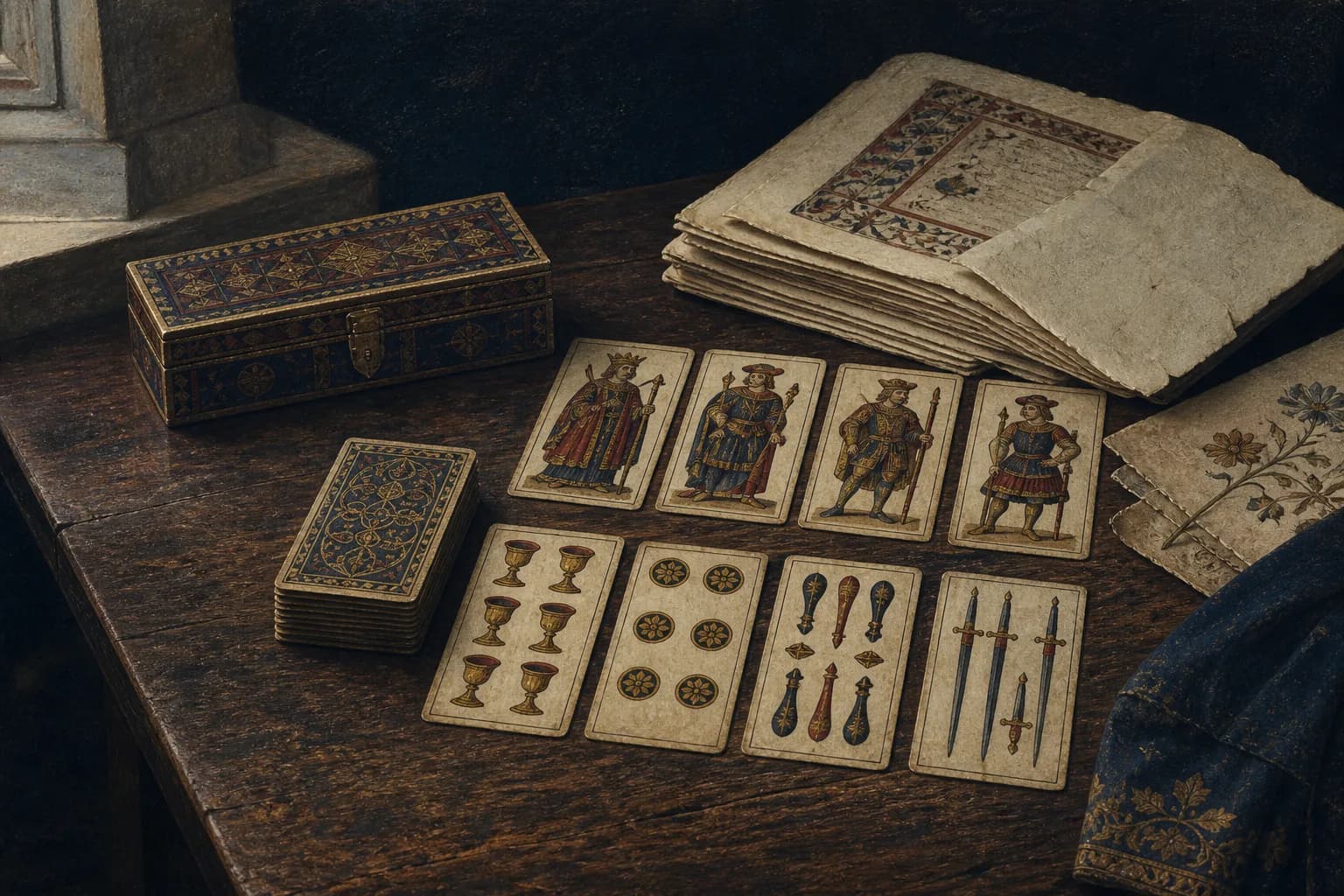
Tarot did not begin as a book of occult wisdom divided into seventy-eight pictures. The earliest surviving cards and written records place it in fifteenth-century northern Italy, where an additional suit of trumps was added to an existing pack for a trick-taking game. Divination became an important part of tarot's history, but it was not its starting point.
The game came before the name “tarot”
Early documents often call the cards carte da trionfi—triumph or trump cards. Records gathered by museums and historians cluster around the middle decades of the fifteenth century and cities or courts including Milan, Ferrara, Florence, Venice, and Urbino. The word tarocchi, from which “tarot” is derived, became common later.
A typical pack combined four ordinary suits, court cards, a Fool, and a sequence of twenty-one trumps. In play, a trump could beat a card from an ordinary suit, while the Fool had a special role that varied by local rules. The Emperor, Pope, Wheel of Fortune, Death, and other figures therefore had to work as recognizable cards in a game before they were treated as stages in a spiritual journey.
This does not make their imagery trivial. It places it in the visual world that first produced it: civic processions, Christian art, moral allegory, courtly rank, and the instability of fortune. Those contexts explain more than a modern keyword projected backward onto an older card.
Survival favors expensive objects
The Visconti–Sforza cards are among the best-known early examples. Their gold leaf, rich pigment, and hand-painted figures make them look like ceremonial treasures. They survived partly because elite owners and later collectors had the means to preserve them.
Ordinary cards tell a less visible story. Cheap packs were handled, bent, stained, discarded, and recycled. Woodblock cards made for wider circulation were far less likely to reach a museum intact. The surviving record is therefore biased toward luxury. What can still be seen today is not a complete inventory of what people used at the time.
That distinction matters whenever an object acquires an aura of secrecy. A costly surviving deck does not prove that tarot was reserved for initiates, any more than an illuminated manuscript proves that ordinary people never told stories.
Divination was built in layers
Playing cards were used for lots, questions, and fortune-telling in early modern Europe, but the claim that fifteenth-century tarot already encoded a complete occult system lacks contemporary evidence. From the late eighteenth century, French writers proposed Egyptian origins and elaborate esoteric histories. Nineteenth-century occultists then developed correspondences with Kabbalah, astrology, elements, and Hebrew letters.
Those later systems are historically important. Many modern reading practices would not exist without them. Their value, however, does not depend on pretending that they were secretly present in every early pack. It is clearer to distinguish at least three layers:
- tarot as a family of card games;
- tarot imagery as a product of particular places and workshops;
- divinatory and occult systems developed by later authors and communities.
The layers can interact without being collapsed into a single origin story.
A better first question for any card
When looking at a card, ask when this image entered the deck and which tradition supplied the meaning you are using. A fifteenth-century trump order, a Marseille print, a nineteenth-century occult correspondence, and a twentieth-century psychological reading are not interchangeable sources.
Naming the source of an interpretation makes a reading more accountable. It lets the reader separate what is visible in the image, what a particular author taught, and what the present interpreter is inferring from the question at hand. Historical clarity does not weaken symbolic practice; it shows where the practice is actually doing its work.
Continue with why emperors, popes, and fools appear in early tarot, then compare the later terminology of the Major and Minor Arcana.