
Origins of Symbols · Tarot History
When Did “Major Arcana” and “Minor Arcana” Become Tarot Terms?
- Author
- Editorial Board, Orphic Meridian Association
- Date
- 2025-02-12
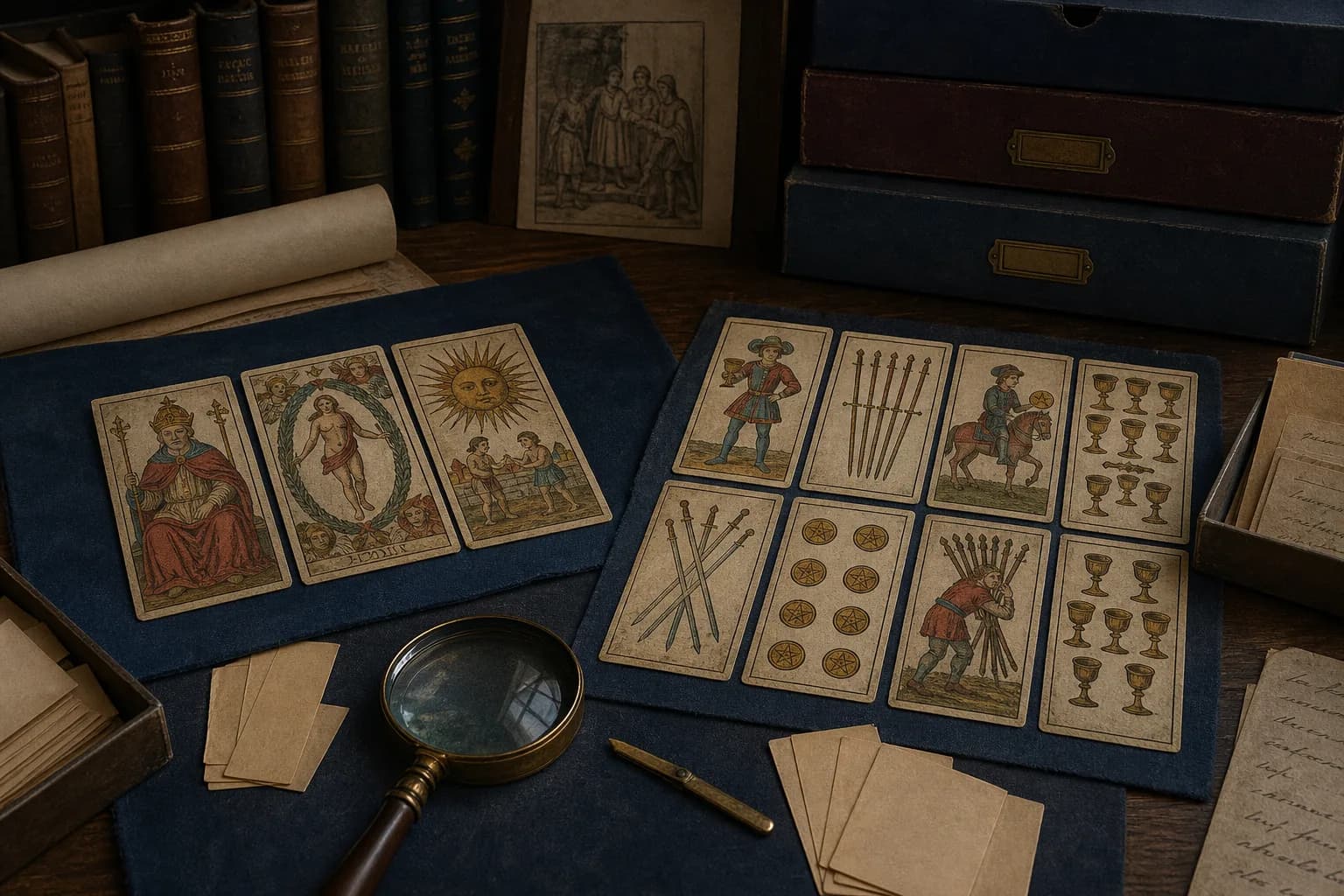
“Major Arcana” and “Minor Arcana” sound like names inherited from tarot's beginning. They are not. Fifteenth-century players dealt with trumps, ordinary suits, court cards, and a Fool. Calling those groups the “greater” and “lesser mysteries” became useful only after writers began presenting tarot as a vehicle for occult knowledge.
The first categories described play
In a card game, the practical distinction is what each card can do. Twenty-one trumps outrank cards from the ordinary suits, while the four suits contain pip and court cards. The Fool follows a special rule. This classification explains play without claiming that one group preserves a higher order of secret teaching.
The word arcana is the plural of Latin arcanum, meaning something hidden, secret, or mysterious. It suited eighteenth- and nineteenth-century attempts to describe tarot as the remains of ancient wisdom. The trumps could then be framed as great universal principles, while the suit cards were assigned to ordinary events or smaller concerns.
That language is interpretive, not neutral. It tells the reader what kind of object tarot is supposed to be before the first card has been examined.
A name can reorganize attention
Once twenty-two cards are called “major,” they easily appear more profound than the other fifty-six. Courses often begin and linger there. The suit cards become an appendix of keywords, even though they supply much of a reading's concrete detail: work, exchange, conflict, care, tools, timing, and relationships.
The hierarchy can also distort practice. A reader may assume that drawing a trump means an event is objectively more important, although importance depends on the question, spread, surrounding cards, and interpretive method. “Major” is a category name, not a measurement instrument.
Knowing where the terminology came from makes it easier to use without being ruled by it. Major and Minor Arcana remain convenient labels, especially across modern decks. They are not the only possible way to organize the pack.
Why the number twenty-two attracted correspondences
Occult authors connected the twenty-two trumps with Hebrew letters, paths on the Tree of Life, astrology, and other symbolic structures. These systems became central to modern Western esotericism. Their tables, however, do not always agree. Authors changed card order, letter attribution, or astrological correspondence to make different systems cohere.
Disagreement is evidence of active construction. It does not make every correspondence useless, but it does require a reader to say which system is being used. Presenting one author's table as tarot's original hidden architecture erases the historical work that produced it.
A clearer order for learning tarot
Start with descriptive categories: trumps, suit cards, court cards, and the Fool. Look at how they functioned in games and how their images changed across time and place. Then study Major and Minor Arcana as a later teaching framework, followed by the correspondences of a named school or author.
This order does not reject esotericism. It lets the student see what a particular esoteric system adds. It also restores the suit cards to the same careful visual attention usually given to the trumps.
Read next about the Marseille tarot as a family of related designs and the way Rider–Waite–Smith transformed the numbered suit cards.
References
Related articles
Origins of Symbols · Tarot History
What the Rider–Waite–Smith Tarot Changed
The deck’s decisive innovation was not simply redrawing the trumps. Pamela Colman Smith turned most numbered suit cards into readable scenes.
Origins of Symbols · Tarot History
Tarot Began as a Card Game, Not a Divination System
Fifteenth-century tarot was a trick-taking card game with a special suit of trumps. Its occult and divinatory systems developed centuries later.
Origins of Symbols · Tarot History
Are Reversed Tarot Card Meanings Ancient or Modern?
Reversed tarot meanings were systematized in modern cartomancy manuals. They are one interpretive method—not a mandatory property of the cards.