
Origins of Symbols · Tarot History
FDL-005
What the Rider–Waite–Smith Tarot Changed
- Author
- Editorial Board, Orphic Meridian Association
- Date
- 2025-03-26
- Reading time
- 4 min
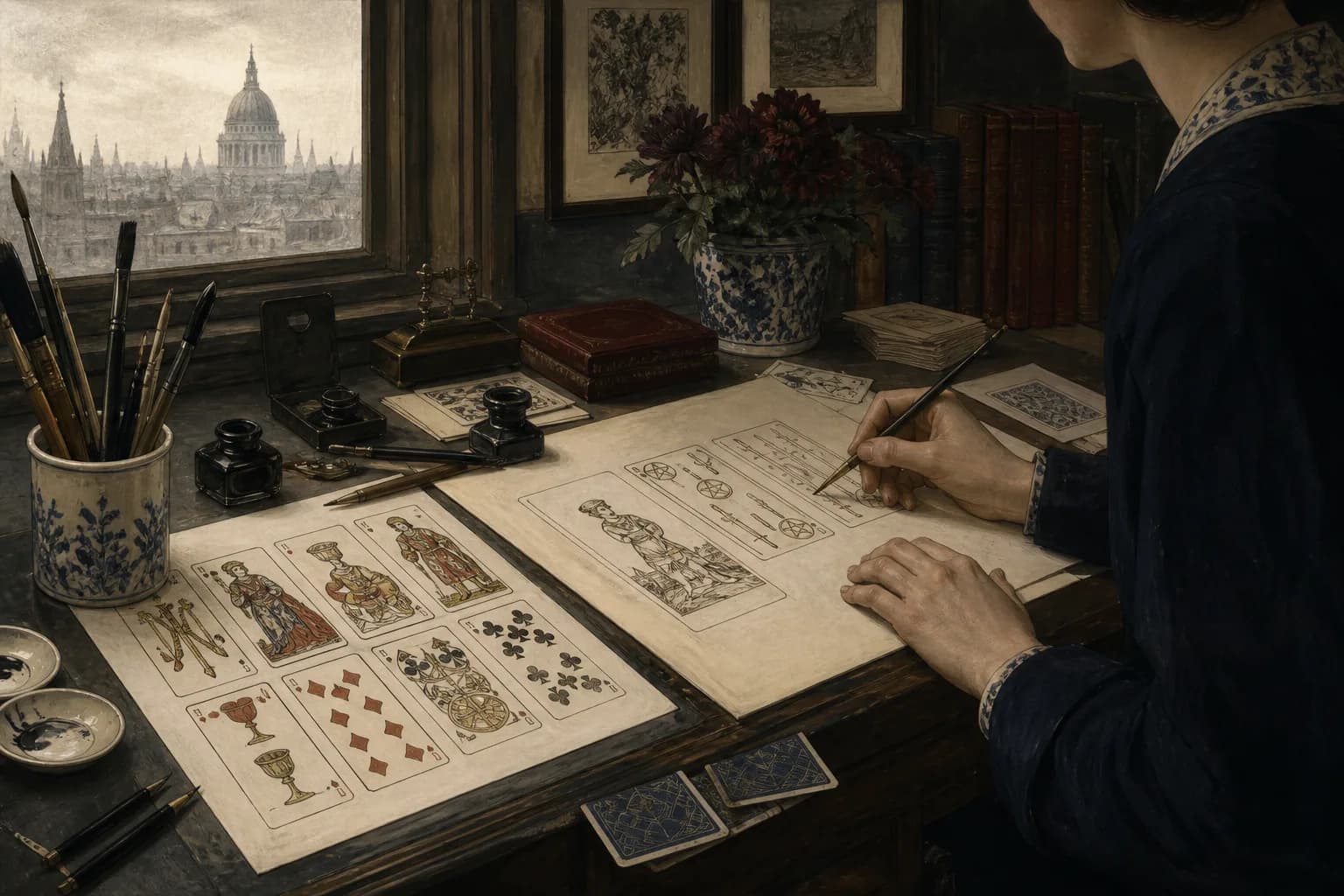
The tarot published by Rider in 1909 did not invent tarot, but it changed how millions of people learned to read it. Its most consequential feature was the union of a particular occult structure with clear narrative scenes, especially across the numbered suit cards. The entire pack became available for direct visual description.
Numbered cards became scenes
In many earlier European tarots, a numbered card primarily shows a quantity of cups, swords, batons, or coins. Interpretation depends on number, suit, inherited rules, and neighboring cards. Pamela Colman Smith instead drew people, actions, and settings for most of these cards: a figure guards coins, another walks away from cups, several people struggle with staffs, and someone waits for a crop.
This lowered one barrier to entry. A reader who did not yet know a table of correspondences could begin by asking what the figures were doing, how they related in space, where they looked, and what might have happened immediately before the scene.
The approach now feels normal because it succeeded. Many modern decks inherit Smith's scene structure even when their art style and stated philosophy are completely different.
Waite was not the only author
The pack was long called the “Rider–Waite,” placing the publisher's name first and leaving the artist unspoken. “Rider–Waite–Smith” or “Waite–Smith” restores Pamela Colman Smith's visible authorship of seventy-eight images.
Arthur Edward Waite specified the broad structure and some iconographic requirements, then discussed the cards in The Pictorial Key to the Tarot. Smith converted a brief and a symbolic program into staging, gesture, costume, expression, and landscape. Their contributions were different and collaborative; neither “Waite designed everything” nor “Smith worked without constraints” adequately describes the result.
Naming matters because it changes what researchers look for. Recognizing Smith leads toward her theatre work, illustration, publishing networks, and other art rather than treating the pictures as anonymous containers for Waite's text.
Order and correspondence were also edited
Waite exchanged the numbered positions of Strength and Justice to align the trump sequence with the correspondences used in his occult tradition. Some cards softened or altered older religious imagery, while others introduced roses, lilies, elemental signs, ritual garments, and details that supported the deck's esoteric program.
These decisions became so widespread that they are often mistaken for tarot's default condition. They are better treated as identifiable early twentieth-century editorial choices. When moving to a Marseille, Italian, or Thoth deck, temporarily setting aside the Waite–Smith grammar makes the other deck easier to see on its own terms.
A scene is evidence, not a verdict
Narrative imagery makes interpretation accessible, but it can also trap a card inside one familiar story. The Five of Cups need not always mean grief, and the Seven of Swords need not always mean deception. A figure's posture, the objects still present, the direction of movement, the spread position, and the question may support a more precise account.
Smith gave readers more to observe; she did not write the conclusion for every future reading. A useful method separates description from inference. First state what is pictured. Then identify the deck convention being used. Only then connect the scene to the matter under discussion.
Compare this visual grammar with the variable family of Marseille designs, and see why reversed meanings remain a chosen method rather than a universal rule.