Origins of Symbols · Tarot History
Tarot de Marseille: A Family of Decks, Not One Fixed Original
- Author
- Editorial Board, Orphic Meridian Association
- Date
- 2025-03-05
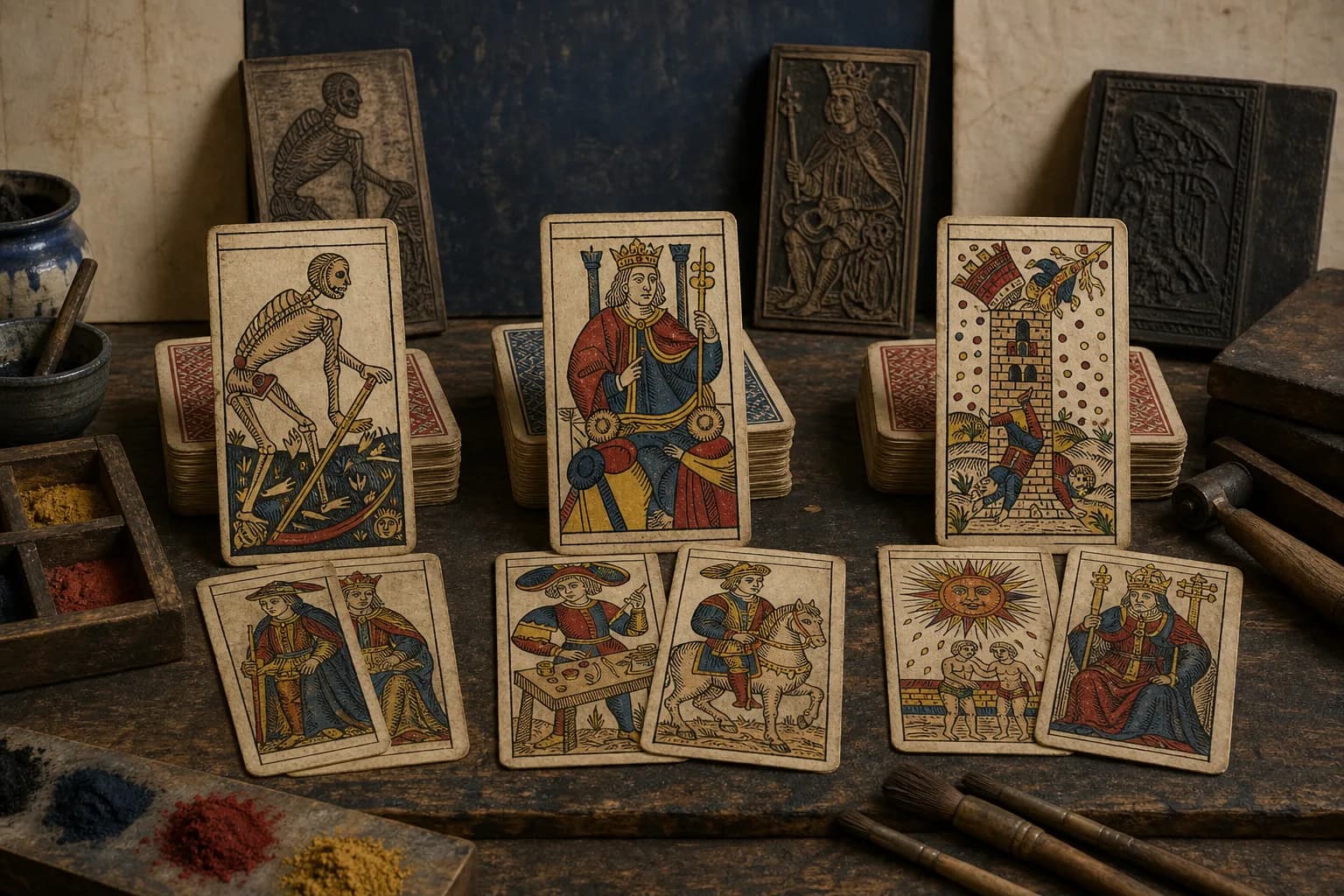
The Tarot de Marseille is often sold as one ancient deck with an original image and a definitive set of meanings. Historically, it is better understood as a family of related printed tarot patterns. Its members share a recognizable visual structure, but no single surviving pack can stand for every workshop, city, and period.
The category is newer than many of the cards
French and Swiss makers printed related designs in large numbers during the seventeenth and eighteenth centuries. They did not all label their products as members of a unified “Marseille system.” The name Tarot de Marseille became established later as collectors, publishers, and historians classified one influential lineage among several regional styles.
Marseille tarot was therefore not a closed work completed once by a known author. Designs moved through woodblocks, stencils, apprentices, family workshops, and trade routes. A copy could preserve the main composition while changing a face, hand, flower, letter, or direction of movement.
The history resembles a manuscript tradition more than a modern copyrighted illustration set: each witness belongs to the tradition and also records a particular act of transmission.
What remains stable—and what moves
The broad cast of trumps, suit structure, and many compositions are readily recognizable. The Hanged Man, Wheel of Fortune, Tower, and World retain enough of a common framework that viewers can compare them across packs.
The revealing differences are often small. Do the Chariot's shoulder ornaments resemble faces or crescents? Which way does the small archer above the Lovers aim? How does the unnamed thirteenth trump hold its scythe? Are the second and fifth trumps given explicitly religious titles? A difference may result from workshop custom, censorship, damage to a block, or one engraver misunderstanding another image.
Not every unusual mark was intended as a secret symbol. Before interpreting a detail, check whether it appears in several related examples or only in one worn impression.
“Oldest” does not mean “only correct”
Modern restorations often promise original colors, corrected lines, or a return to the oldest version. Restoration can be valuable, especially when it makes damaged historical material usable. Yet every restored deck answers editorial questions: Which pack is the base? How are missing cards supplied? Are faded colors reconstructed? Is an irregular line preserved as evidence or corrected as damage?
A remarkably clean edition is not free from modern judgment. Its publisher should identify the source deck, museum object, facsimile, or combination of witnesses used. “Authentic” without a source note is a marketing claim, not a method.
Comparison is more useful than memorizing anomalies
Place two or three dated, attributed decks side by side. First record the shared composition. Then list the differences without interpreting them. Finally ask which differences are consistent enough—or culturally specific enough—to affect a reading.
This approach avoids turning accidental marks into doctrine. It also reveals how tradition works: continuity is visible in what makers retained, while historical change is visible in what they remade.
For contrast, see how the Rider–Waite–Smith deck made scenes from numbered cards. The opening article explains the card-game origins shared by early tarot traditions.
References
Related articles
Origins of Symbols · Tarot History
Are Reversed Tarot Card Meanings Ancient or Modern?
Reversed tarot meanings were systematized in modern cartomancy manuals. They are one interpretive method—not a mandatory property of the cards.
Origins of Symbols · Tarot History
What the Rider–Waite–Smith Tarot Changed
The deck’s decisive innovation was not simply redrawing the trumps. Pamela Colman Smith turned most numbered suit cards into readable scenes.
Origins of Symbols · Tarot History
When Did “Major Arcana” and “Minor Arcana” Become Tarot Terms?
Fifteenth-century players spoke of trumps and suits. Major and Minor Arcana are later occult classifications that changed how tarot was taught.