
Origins of Symbols · Tarot History
FDL-006
Are Reversed Tarot Card Meanings Ancient or Modern?
- Author
- Editorial Board, Orphic Meridian Association
- Date
- 2025-04-16
- Reading time
- 4 min
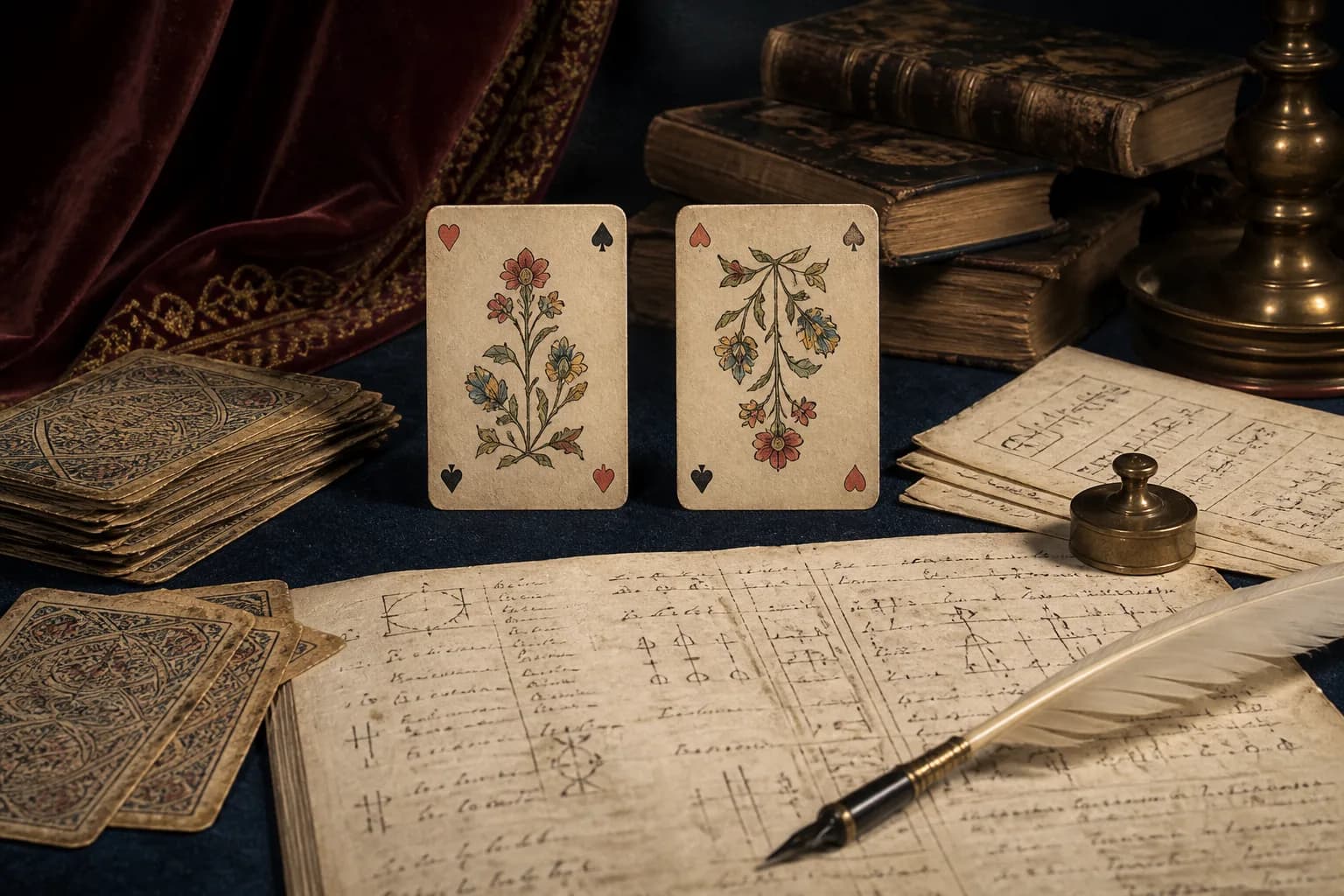
Reversed meanings did not originate with tarot cards themselves. In early tarot games, the orientation of a card did not carry the divinatory significance familiar to many readers today. Separate upright and reversed meanings became systematic through modern cartomancy manuals and were later reinforced by influential tarot books.
What is supposed to change when a card turns?
Reversal methods offer several different answers. An upright quality may be blocked, directed inward, weakened, exaggerated, delayed, or turned into its opposite. These rules are not equivalent. “Authority is obstructed” and “authority is abused,” for example, lead to different interpretations even though both might be filed under a reversed Emperor.
A reversed card therefore does not generate a second keyword automatically. The reader has to choose a principle and apply it consistently across the spread. Switching principles only when an uncomfortable card appears turns reversals into a way of escaping evidence rather than adding information.
Some readers use a small number of reversal categories and decide between them from the question and surrounding cards. Others assign a distinct reversed definition to every card. The first approach demands transparent reasoning; the second demands a very large memory. Neither is inherent in the cardboard.
How manuals made reversals familiar
Eighteenth- and nineteenth-century cartomancy manuals often printed upright and reversed definitions in parallel. Etteilla's system and later British and American tarot literature helped normalize the format. Waite's Pictorial Key to the Tarot also provided reversed meanings for most cards, making the idea of two entries per card widely available to English-language readers.
Not every tarot tradition adopted the method. Marseille readers may use spread position, neighboring cards, elemental balance, or the direction a figure faces. Some contemporary readers keep every card upright while distinguishing constructive, constrained, and excessive expressions of the same image.
The existence of several workable methods is a reason to document method, not evidence that method is irrelevant.
Decide whether the additional signal pays for itself
Reversals can add a visible signal for obstruction, internalization, or imbalance. They can also mechanically double a beginner's vocabulary and encourage the false rule that upside down always means bad.
Before using them, answer three operational questions:
- Does the shuffling method genuinely allow cards to rotate?
- Which reversal principle will govern the reading?
- What happens when a card is only slightly turned or its orientation is unclear?
If these questions have no stable answer, reading upright cards with greater attention is more reliable than improvising a reversal system mid-session.
A reversed card is not a risk alarm
No orientation replaces factual investigation, medical assessment, legal advice, or the decision of the person asking the question. Reversed cards can create extra tension because they look visibly disrupted. In public-facing practice, describe the observation first, name the interpretive rule, and state uncertainty before suggesting consequences.
Reversal is best treated as an optional layer of syntax. It can be useful when both reader and client understand what it is doing; it should not be presented as an unavoidable warning built into the deck.
For related method questions, examine how Rider–Waite–Smith scenes shape modern reading and why the Major and Minor Arcana are historical categories.