
Origins of Symbols · Tarot History
FDL-002
Why Early Tarot Included the Emperor, Pope, and Fool
- Author
- Editorial Board, Orphic Meridian Association
- Date
- 2025-01-22
- Reading time
- 4 min
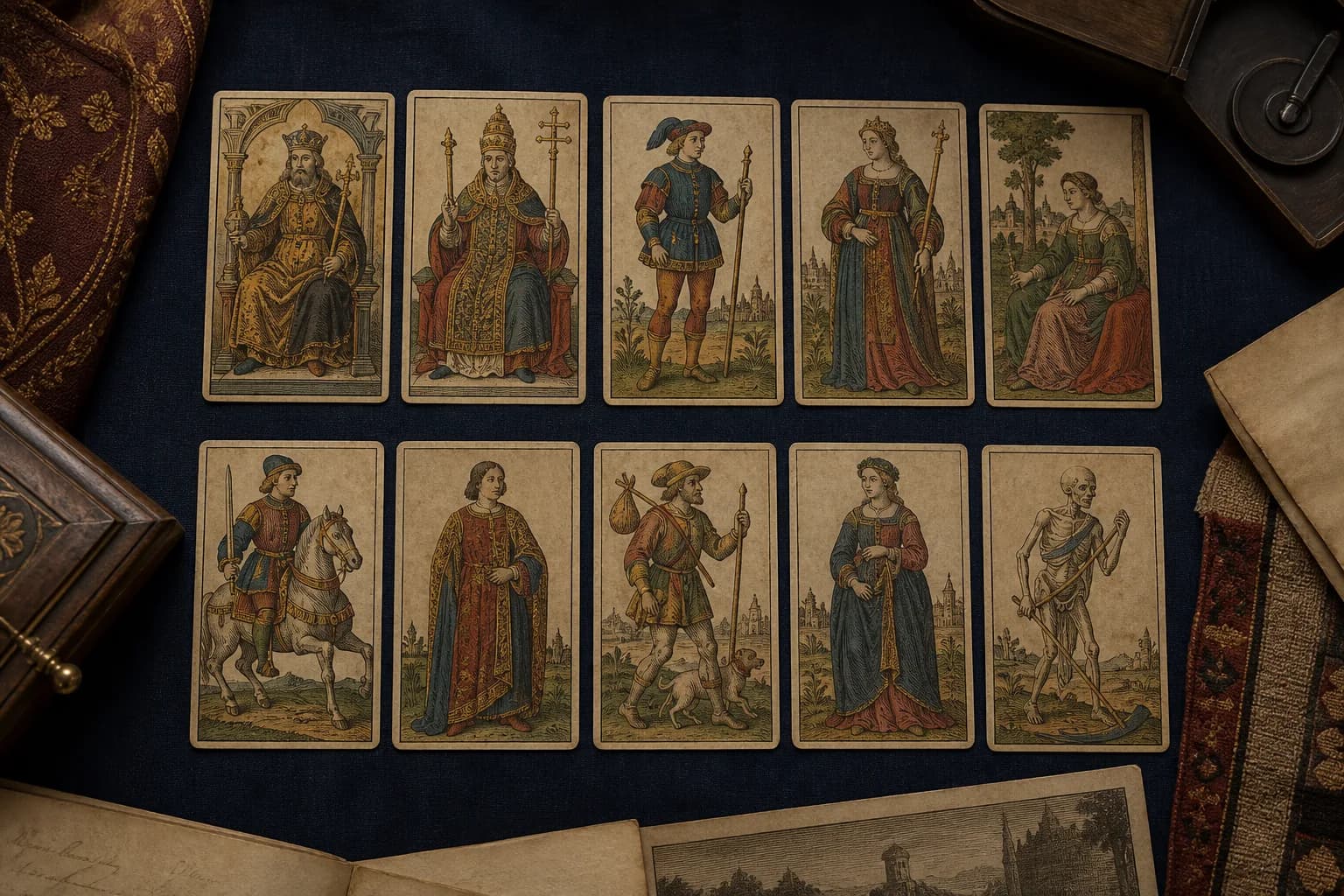
The Emperor, Pope, and Fool did not enter tarot because its first designer had already composed a universal path of initiation. A more historically grounded explanation is also more interesting: early trump cards used people and allegories that their audience could recognize immediately, then arranged them in an order that could function during play.
A trump sequence needed recognizable rank
Trick-taking games depend on hierarchy. Ordinary suits already used numbers and court figures; the added trumps needed another sequence that players could identify and compare. Emperors, popes, virtues, Fortune, Death, and the Last Judgment all belonged to the common visual language of late medieval and Renaissance Europe.
The same subjects appeared in church art, manuscripts, civic pageants, triumphal processions, sermons, and moral drama. A player did not need an occult handbook to understand that the Emperor represented high temporal authority, that the Pope represented religious authority, or that Fortune could overturn both.
The cards did not merely reproduce society, however. By placing rank beside instability, death, and judgment, the sequence could turn social order into a compact moral spectacle. That gave later interpreters rich material, but the later interpretation should not be confused with the card's original function.
Why the Fool sits awkwardly inside the order
The Fool occupies a productive contradiction. In social imagery, a fool could be marginal, uncontrolled, licensed to mock authority, or unable to participate in ordinary reason. In play, the card often had a special exemption rather than simply being the highest or lowest trump. It could allow a player to avoid following suit or preserve the card under particular rules.
Image and function therefore echo one another: the Fool appears within the order without fully submitting to it. This is not the same as the later convention of numbering the Fool zero and treating it as the first step of a spiritual journey. That convention has become influential, but early packs were not always numbered, and regional trump orders were not uniform.
The figures were never completely fixed
“The Pope” was not an untouchable template. Some makers altered sensitive religious titles or substituted different figures. Other regional games expanded the sequence: the Florentine Minchiate, for example, included additional virtues, zodiac signs, and elements.
Early tarot is therefore better understood as a related family of games and images than as one immutable set of seventy-eight cards. When comparing a figure across decks, record four things before assigning meaning: the pack, approximate date, place of production, and position in the sequence. A shared title can conceal substantial visual and historical differences.
What these figures can mean now
In a contemporary reading, the Emperor may raise questions about order, authority, institutions, or control. A Pope or Hierophant may concern tradition, transmission, education, or organizational legitimacy. The Fool may point toward risk, mobility, exclusion, or freedom from a rule.
None of those possibilities is an automatic answer. A responsible interpretation shows its path: describe the card, identify the relevant historical or deck-specific convention, connect it to the question, and state the inference with appropriate uncertainty. This makes the meaning discussable rather than treating a memorized keyword as revelation.
For the broader historical setting, begin with tarot's origin as a card game. The next article explains why the terms Major and Minor Arcana are later classifications.