
Origins of Symbols · Calendars and Bazi
Why the Bazi Month Pillar Uses Solar Terms, Not Lunar Months
- Author
- Editorial Board, Orphic Meridian Association
- Date
- 2026-02-25
The “month” in Four Pillars is not the period from the first to last day of a lunar month. Month branches change at twelve of the twenty-four solar terms: Lichun begins Yin month, Jingzhe begins Mao month, and so on.
The two months observe different cycles
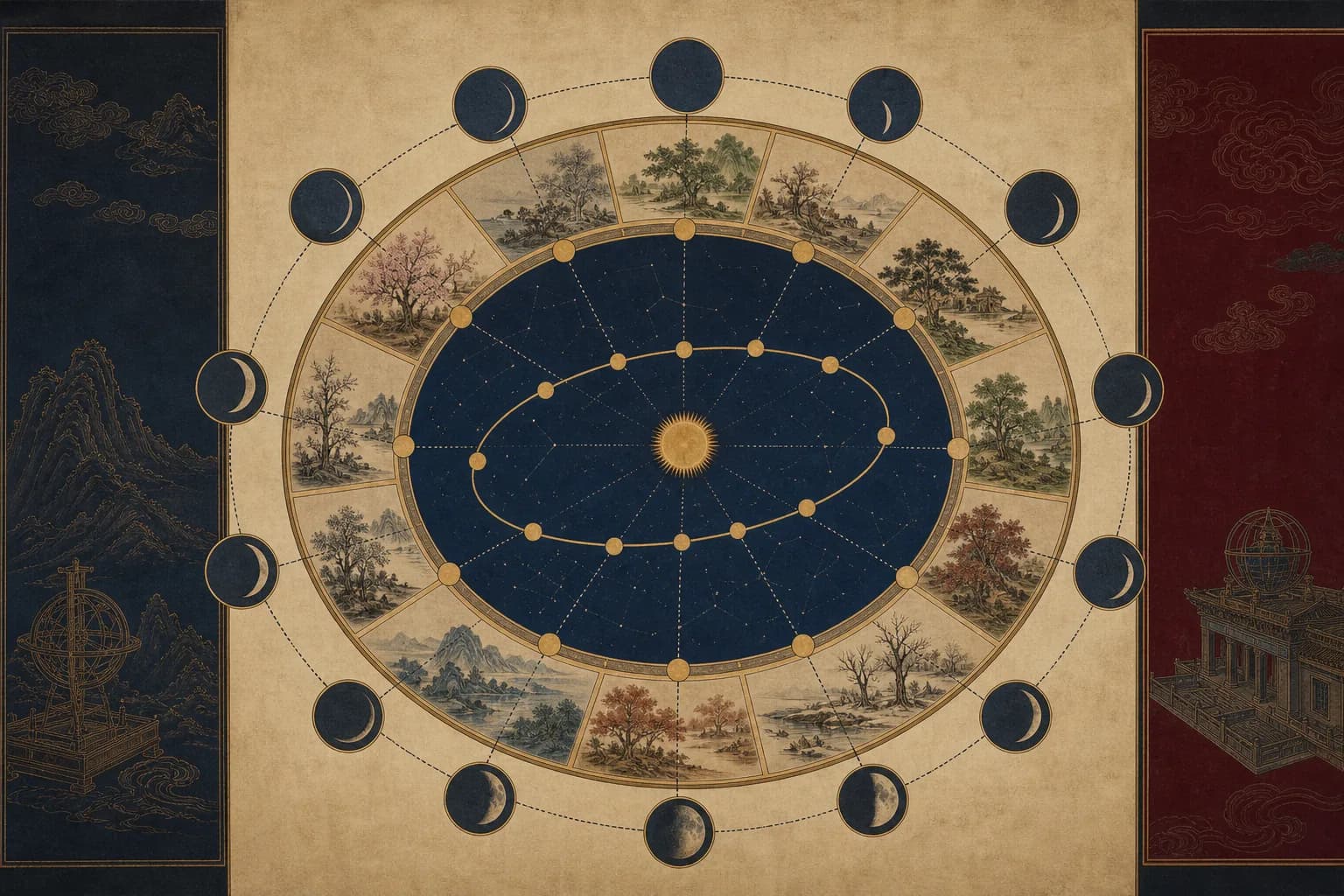
A lunar month starts at new moon and lasts twenty-nine or thirty days. A seasonal month follows solar longitude, with boundaries about thirty degrees apart. New moons move through these solar intervals, and leap months reconcile the lunar sequence with the solar year.
Using solar-term boundaries keeps twelve month branches without requiring a repeated branch in a leap month.
“Jie” and “qi” alternate
The twenty-four terms alternate between twelve jie and twelve middle terms. Month pillars change at Lichun, Jingzhe, Qingming, Lixia, and the other jie—not at every fifteen-degree point. Crossing the spring equinox does not itself change the month pillar.
The month branch comes from the season; the month stem is derived from the year stem. “Lunar February” identifies neither the branch nor the complete pillar. Yin month is not simply February or the first lunar month.
Preserve uncertainty at the boundary
Use the exact solar-term time for births near a transition. If the original time says only morning or afternoon, retain both possible pillars rather than creating false precision.
Three calendars should not be collapsed into one label
Gregorian February, the second lunar month, and the Mao seasonal month can overlap without sharing boundaries. Converting one into another requires an actual date and the rule of the target system. A phone-calendar label is not enough to infer a month pillar.
For teaching, plot the twelve jie boundaries on one annual line and the new moons on another. Their shifting relationship makes leap months and month-pillar differences visible and explains why a seasonal year still has twelve divisions.
Compare Lichun and Lunar New Year year boundaries and time standards for the hour pillar.
References
Related articles
Origins of Symbols · Calendars and Bazi
How the Heavenly Stems and Earthly Branches Recorded Time
The ten stems and twelve branches advance together rather than pairing freely, producing a fixed sixty-step cycle used to number days and years.
Origins of Symbols · Calendars and Bazi
The Ten Gods in Bazi Are Ten Relationships, Not Ten Deities
The Ten Gods name relationships between the Day Master and other stems according to Five Phase generation, control, and yin-yang polarity.
Origins of Symbols · Calendars and Bazi
The Five Phases Are Not Five Basic Substances
Wood, fire, earth, metal, and water have material images, but wuxing also describes functions, directions of change, and relationships.